- icy@wzhgroup.com
- +86 15081877521


Over the past few years,modular construction has been entering the global market at a remarkably rapid pace.From construction site camps and mining accommodation to temporary office spaces—and even tourism and resort projects—an increasing number of projects are opting for a faster,more flexible construction method:the container house.
Throughout this process,the concept of an"OEM container house manufacturer"is frequently mentioned;however,many people do not truly understand what it entails.It represents more than just a specific type of supplier;it signifies a fundamental shift in production methodology.
From a practical application perspective,this article will guide you through exactly what an OEM container house factory does,outline its production workflow,and explain why an increasing number of engineering projects are choosing this collaborative approach.
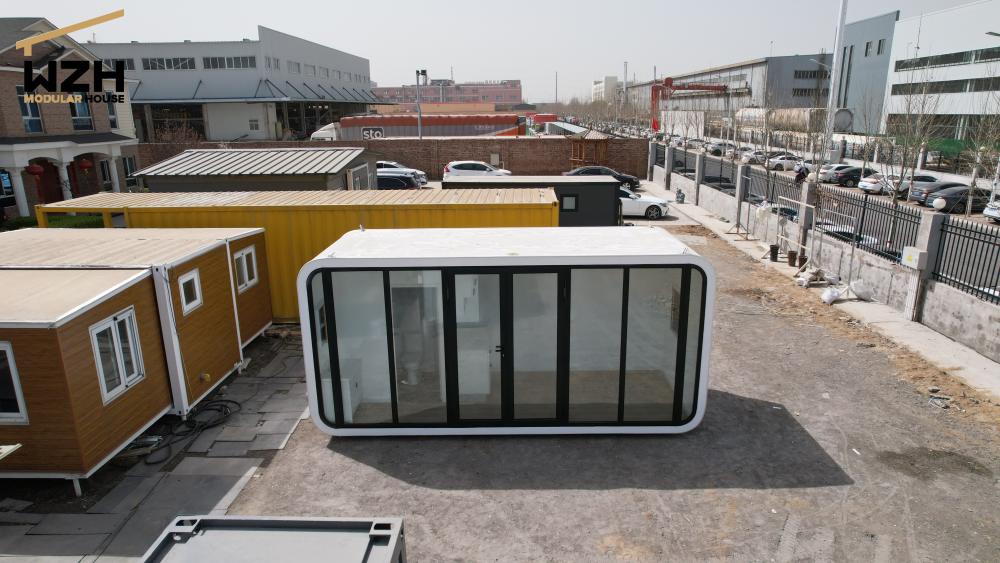
An OEM(Original Equipment Manufacturer)container house manufacturer refers to a factory or enterprise that produces container houses on a customized basis,strictly adhering to a client's specific design,branding,or technical specifications.
Under this model,the manufacturer does not primarily focus on selling pre-existing,standard products.Instead,they assume responsibility for the entire process—encompassing structural design,material procurement,manufacturing,and quality control—while also offering support for client-specific branding(Private Labeling)or bespoke engineering customizations.
In essence,you can think of it as a"factory for on-demand production."You can provide a complete design,or simply offer a conceptual idea;the factory then takes charge of transforming that spatial vision from blueprints into a tangible physical structure.
For instance,you might outline the specific scenario for which you require the structure—such as mining site dormitories,construction site offices,or temporary residential housing.The factory will then tailor the structural design and overall solution to meet these specific requirements,rather than simply supplying a generic,fixed product.
Subsequently,the design team breaks down every element—including the spatial structure,layout,electrical systems,and insulation layers—before moving into the factory production phase.Throughout this process,your level of involvement remains quite high.Some projects even undergo specialized optimization to account for local climatic conditions and transportation logistics.
In other words,engaging an OEM is not merely about"buying a product";it is more akin to"collaboratively realizing an architectural solution."
The production process for OEM container houses typically comprises several key stages:requirements consultation,solution design,structural engineering calculations,factory manufacturing,pre-assembly inspection,packaging and transportation,and,finally,on-site installation.The entire process begins with your specific requirements;the factory handles the complete workflow—from design to manufacturing—and conducts rigorous quality verification prior to shipment,ensuring that the finished product can be deployed safely and rapidly across various countries and project sites.
Submit Your Design Requirements
The first step in an OEM container housing project actually begins with the question,"What kind of space do you envision?"rather than jumping directly into production.The factory will first engage in detailed consultations with you to understand the project's intended purpose—whether it is for construction site dormitories,mining camps,or temporary office and residential spaces.
Concurrently,they will verify essential yet critical details,such as the expected service life,structural height(number of stories),budget parameters,and local climatic conditions.In many cases,the ultimate success or failure of a project hinges entirely on the clarity of this initial information.
At this stage,the focus is not merely on"what product to build,"but rather on systematically refining a concept—determining room layouts,door and window placements,and the need for any extended functionalities.It can be best understood as a gradual evolution from a mere"abstract concept"into a"concrete,actionable spatial solution."
Once you and the factory have finalized the project requirements,the process moves into the design and engineering calculation phase.This step is pivotal,as it determines whether the container housing will be truly functional,durable,and safe.
Container housing is,fundamentally,a form of steel-structure architecture;as such,it necessitates careful consideration of numerous real-world factors—including wind loads,snow loads,transportation-related vibrations,and long-term structural stability.Reputable OEM container housing manufacturers employ professional design teams capable of optimizing the overall design to effectively address these specific conditions.
If the project is situated in a different country or region,a competent manufacturer will also adapt the design to comply with local building codes and standards—for instance,by reinforcing structural strength or optimizing the thermal insulation system.While this process may sound highly technical,it directly dictates the housing unit's ability to perform reliably and stably over the long term within its actual operating environment.
Once the design proposal and structural specifications have been confirmed,the project proceeds to the production phase.At this juncture,the blueprints cease to be mere drawings and begin to transform into tangible,physical products.
Adhering strictly to the approved design plan,the factory undertakes the cutting,welding,and assembly of steel components to construct the primary structural framework.Simultaneously,the installation of wall systems,flooring,electrical wiring,and thermal insulation layers is carried out in parallel to ensure the structural integrity and completeness of the entire unit.Although the entire production process may appear highly standardized,in reality,every project undergoes detailed adjustments based on specific requirements;it is not merely a matter of simple replication.In a professional OEM facility,each container house is treated as a distinct,independent project,thereby ensuring the quality of the final delivery.
Before the product officially leaves the factory,a pre-assembly test is typically conducted—meaning the entire structural unit is fully assembled once within the facility.The purpose of this step is to identify any potential installation issues or structural deviations in advance.
Concurrently,waterproofing tests,electrical system checks,and door and window seal inspections are performed to ensure that all systems function correctly under real-world operating conditions.
While this stage adds slightly to the production lead time,it effectively mitigates on-site installation risks and enhances the overall reliability of the final delivery.
Once inspections are complete,the product moves into the packaging and transportation phase.Given the inherent modular nature of container houses,transportation efficiency is typically a key consideration during the initial design phase.
For instance,collapsible structures can significantly reduce shipping volume,while modular disassembly improves container loading efficiency,thereby lowering logistics costs.For international projects,this phase often has a substantial impact on the overall budget.
Consequently,reputable OEM manufacturers typically optimize transportation strategies during the design phase rather than attempting to address them as a separate afterthought.
Once the container house arrives at the project site,it enters the final installation phase.Since the majority of the structural work has already been completed at the factory,on-site work is limited to assembly and basic connections,making the installation process relatively simple and efficient.
Typically,a standard module can be fully installed within a short timeframe;some projects can even be ready for occupancy within just a few hours.Manufacturers generally provide comprehensive installation manuals,and for certain projects,they may also offer remote support or on-site technical assistance.
This stage is,in fact,the most"relaxed"part of the entire OEM process;because the complex manufacturing work has already been completed upstream,the on-site phase resembles a rapid assembly process rather than traditional construction work.
When selecting an OEM container house manufacturer,many people initially focus on price;however,true value often lies in the controllability of the cost structure.Compared to traditional procurement models,OEM partnerships eliminate intermediaries,making overall expenses far more transparent.
You gain clear insight into the cost breakdown for each stage—design,production,and transportation—rather than merely seeing a single,final quotation.This is particularly crucial for engineering projects,as it implies greater budgetary control and more predictable risks.
Selecting an OEM manufacturer essentially means choosing a"project-specific production"capability,rather than having to compromise by selecting from existing off-the-shelf products.
Whether it concerns spatial layout,aesthetic style,or internal functional configurations,every aspect can be tailored to fit the specific application scenario.The unique differences between various projects are no longer viewed as limitations,but rather as challenges that can be effectively resolved.
For instance,engineering projects typically prioritize structural integrity and durability,whereas commercial or residential projects tend to focus more on design aesthetics and comfort.The distinct advantage of the OEM model lies in its ability to simultaneously satisfy these divergent requirements.
OEM container house manufacturers typically employ a"factory prefabrication+on-site assembly"model,a method that can significantly reduce the overall project delivery timeline.
Since the majority of complex manufacturing processes are completed within the factory environment,the on-site work is reduced to simple assembly,thereby drastically cutting down construction time and minimizing uncertainties.For projects with strict time constraints,this represents a highly practical and tangible advantage.
Particularly in scenarios involving tight deadlines or an urgent need for rapid deployment,this capacity for efficient delivery often has a direct and decisive impact on the project's overall progress.
In contrast to the inherent uncertainties associated with on-site construction,OEM manufacturers are better positioned to implement standardized quality control measures.Since the entire production process takes place within the factory,consistency can be guaranteed through the application of uniform procedures and rigorous inspection standards.
Furthermore,specialized manufacturing facilities typically possess in-house engineering design expertise and comprehensive quality assurance systems,enabling them to identify and resolve most potential issues*before*the products leave the factory.This approach—known as"front-loaded control"—helps to minimize the risks of subsequent maintenance issues and costly rework.
From a long-term perspective,this not only enhances the operational stability and reliability of the structures but also contributes to a reduction in overall lifecycle costs.
Choosing an OEM container house manufacturer involves more than just executing a one-time procurement transaction;it signifies the establishment of a long-term,collaborative supply partnership.
Many clients leverage the OEM model for private-label branding,localized distribution,or to secure a stable and reliable supply source for their ongoing,long-term projects.This collaborative framework empowers businesses to gradually build out their own distinct product portfolios and cultivate a competitive edge within the market.
For clients requiring a continuous supply of units or those managing multiple concurrent projects,a stable and dependable OEM manufacturing partner holds far greater strategic value than a series of isolated,one-off purchases.
An OEM Container House Manufacturer is an ideal choice for users with specific customization needs,as well as for corporate clients requiring a stable supply,rapid delivery,and long-term supply chain partnerships.
Compared to simply purchasing standardized products off the shelf,these clients prioritize project compatibility,cost control,and overall delivery efficiency;consequently,they tend to favor OEM factories that possess integrated design and manufacturing capabilities.
For construction firms and infrastructure contractors,projects typically come with defined timelines and specific delivery mandates.Their primary focus lies in supply stability and the ability to meet scheduled delivery deadlines,rather than on the individual product unit itself.
By partnering with an OEM Container House Manufacturer,these clients gain access to integrated support—spanning everything from design to production—thereby reducing communication overhead and boosting project execution efficiency.This model is particularly well-suited for clients whose operations are driven by a project-centric approach.
Mining and energy projects are often situated in remote locations,placing heightened demands on construction efficiency and transportation cost-effectiveness.In such environments,traditional construction methods are often prohibitively expensive,time-consuming,and highly susceptible to environmental disruptions.
The modular solutions offered by OEM manufacturers allow the majority of the production work to be completed within the factory setting,enabling rapid on-site assembly.This approach is ideally suited for project types that require rapid deployment and large-scale implementation.
As they advance their projects,real estate developers often face constraints such as tight deadlines,limited budgets,or the need for rapid capital turnover.In these scenarios,a flexible construction methodology becomes critically important.
By engaging an OEM Container House Manufacturer,developers can customize products to align precisely with project requirements while maintaining flexible control over the development pace.Whether the need is for short-term residential units,workforce housing,or phased development initiatives,this model offers a high degree of adaptability.
For clients focused on sales within local markets,the product itself serves merely as a foundation;of far greater importance are the stability of the supply chain and the potential for brand building.
OEM manufacturers typically offer support for private-label production and long-term supply agreements.This enables distributors to establish their own distinct brand identities rather than simply acting as resellers of generic products.From a long-term perspective,this collaborative model is highly conducive to market expansion and business growth.
Selecting a reliable OEM Container House Manufacturer has a direct and significant impact on your project's timeline.You should never base your decision solely on price quotes;instead,you must closely evaluate the factory's production capacity,its manufacturing and engineering capabilities,and even its experience with international exports—as logistical bottlenecks during shipping can just as easily derail your project schedule.
Assess Production Capacity:Capacity signifies a factory's ability to complete orders stably and on time—not merely its ability to accept them.A factory equipped with a mature production system can typically handle bulk orders and project fluctuations,ensuring that delivery schedules remain uninterrupted.Compared to price,stable production capacity has a more direct impact on the smooth progression of a project.
Assess Engineering Capabilities:Engineering capability determines whether a factory merely"manufactures products"or possesses the ability to"solve problems."Factories capable of providing structural design and engineering calculation support can typically handle more complex project requirements,rather than being limited to standardized products.This is particularly crucial for clients with specific customization or engineering demands.
Assess Export Experience:Export experience reflects a factory's adaptability to international projects,encompassing standards,logistics,and execution protocols.Factories with experience in projects across multiple countries are typically more familiar with the regulatory requirements of different regions,thereby reducing communication overhead and potential risks.For overseas procurement,this serves as a vital criterion for assessing reliability.
Assess Comprehensive Service Support:The core of an OEM partnership lies not solely in the product itself,but in the capability to provide holistic solutions.A mature factory can typically cover the entire scope—from design,production,and transportation to installation support—thereby minimizing the uncertainties inherent in intermediary stages.Compared to relying on a single-function supplier,such integrated services are far more conducive to the efficient realization of a project.
If traditional construction is understood as"building a structure piece by piece on-site,"then OEM container housing is akin to"pre-fabricating the entire house within a factory setting."It shifts the construction phases—which are typically complex,time-consuming,and susceptible to environmental variables—into a controlled factory environment,leaving only rapid assembly and basic utility connections to be completed on-site.
This approach is not intended to replace traditional construction,but rather to offer a more efficient and controllable solution for specific scenarios.For many engineering projects,the fundamental challenge to be addressed is no longer simply"do we have a building?"but rather,"can we deliver and commission it faster and more reliably?"
If you are currently seeking a reliable OEM container house manufacturer,WZHhouse is a worthy contender to consider.As a container housing manufacturer based in China,WZHhouse specializes in customized production and OEM partnerships,offering integrated support—from design to manufacturing—tailored to the unique requirements of each project.
Whether for engineering projects,camp construction,or distribution and brand collaborations,WZHhouse offers flexible solutions to meet your needs.If you would like to learn more about specific solutions or request a quotation,please feel free to contact them directly to receive customized recommendations best suited to your project.



Copyright © Hebei Weizhengheng Modular House Technology Co., Ltd. All Rights Reserved
Sitemap

 +8615081877521
 +8615081877521