- icy@wzhgroup.com
- +86 15081877521


In the homestay and short-stay accommodation market,a clear trend is emerging:more and more investors are focusing on container houses,especially high-end luxury products with more sophisticated designs and configurations.This change is driven not by a single factor,but by the combined effects of multiple realities—construction cost structure,project cycle,capital utilization efficiency,and differentiated market demands.
Under traditional construction methods,the cycle from design to completion for a small boutique homestay often takes 6–12 months,or even longer.This involves multiple processes including civil engineering,structural construction,decoration,water and electricity,and approvals.In contrast,modular container houses can typically compress the overall delivery time to 4–10 weeks(excluding complex site development).This time difference is significant in investment models because,for commercial projects,delayed operation itself is a cost.
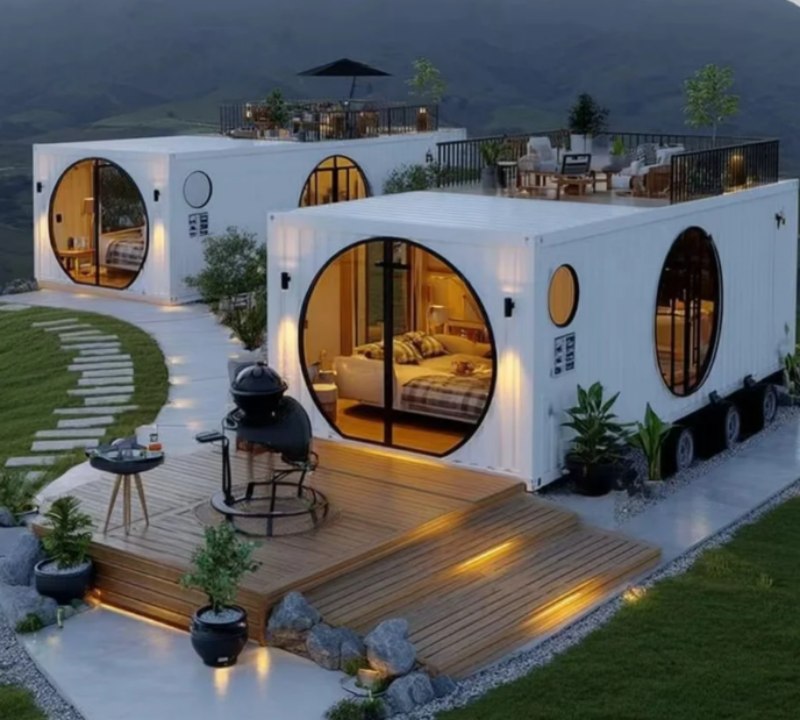
Budget mismanagement is a common risk in homestay investment.Traditional construction is significantly affected by construction conditions,labor costs,and material fluctuations,making it not uncommon for the final cost to deviate from the initial estimate.Because container houses are prefabricated in factories,most of the structure and interior decoration are completed during the production stage,resulting in a more concentrated cost range.
Common examples from North American and international markets:
Standard accommodation container unit(basic configuration):Approximately US$15,000–US$30,000
High-end or luxury configuration unit(including separate bathroom,insulation system,and customized interior decoration):Approximately US$30,000–US$60,000
The differences mainly stem from three aspects:insulation level(affecting year-round use),interior decoration standards,and door,window,and equipment configurations.It's worth noting that while luxury modules are more expensive than basic units,their cost fluctuations are relatively smaller.For investors,this means it's easier to build a reliable model during the financial calculation phase,rather than constantly adding to the budget during construction.
In traditional construction,decoration costs often account for 30%–50%of the total cost and are easily affected by design changes.Modular products are mostly delivered as a whole,significantly reducing uncontrollable expenses later on.
Foundation and civil engineering are often among the most difficult costs to control in accommodation projects.Traditional buildings require a complete foundation structure,typically accounting for 20%–35%of the cost.Container houses can utilize lightweight foundations or point-supported structures in many scenarios,reducing the amount of work required.
In suitable sites:Foundation and site preparation costs for container houses are typically around$5,000–$15,000 per unit area,representing approximately 10%–20%of the overall project investment.
Of course,this doesn't apply to all terrains.Complex geology,mountainous areas,and coastal regions still require specialized engineering design.However,simplified foundation structures are a common practice in environments such as scenic areas,farms,and resort camps.
Furthermore,some regions offer more flexible approval processes for modular buildings,indirectly reducing time and management costs.This is particularly evident in cross-regional projects.
Differences in construction cycles directly impact investment models.Assuming a project with a total investment of 1 million yuan and a construction period of 12 months,it means no operating revenue for a full year.However,a modular container project,if deployed within 2-3 months,can generate cash flow approximately 9 months earlier.
In the accommodation industry,opening earlier is often more valuable than simply saving costs.This is because fixed costs(rent,management,interest,etc.)persist during periods without revenue.
Under the same occupancy rate and room rate assumptions,opening earlier will significantly improve the payback period and internal rate of return.Using a simplified model as an example:
Average room rate:USD$80–$120 per night
Average annual occupancy rate:55%–65%(a common range for tourism and glamping projects)
Estimated annual revenue per room:approximately USD$16,000–$28,000
If the project construction period is shortened by more than six months,investors can often cover some fixed expenses earlier.In many real-world examples,the payback period for container homestay projects falls within the 2-4 year range,while traditional self-built homestays typically take 4-6 years or longer.The core difference isn't the price,but rather the investment and operational pace.
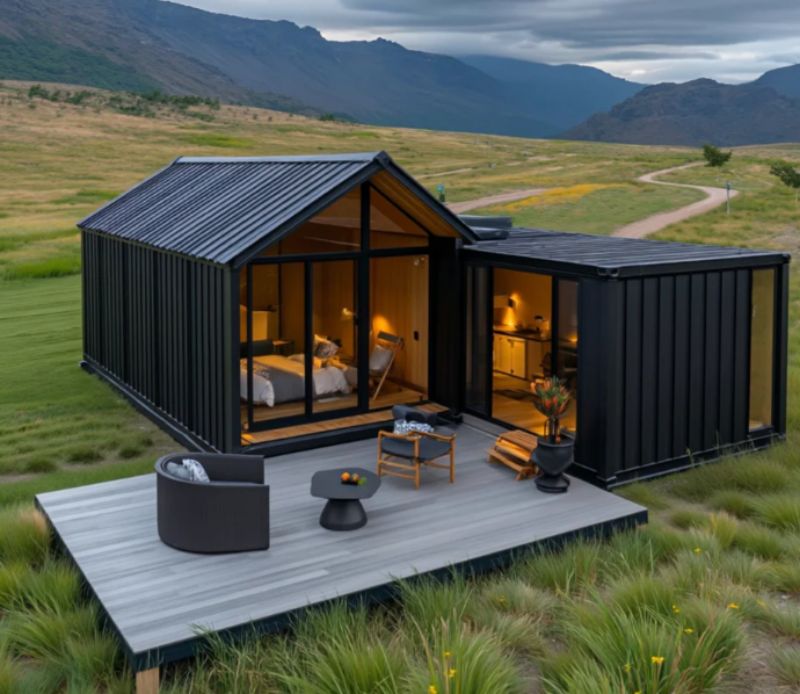
Traditional property investment often requires completing the entire construction scale at once.If market demand falls short of expectations,idle costs are high.Modular construction allows for phased investment,such as deploying 5 units initially and adding more based on occupancy rates.
This strategy financially reduces demand forecasting risk.Investment is no longer"all or nothing,"but rather closer to a gradual layout.
In the long-term cost structure of accommodation projects,maintenance and renovation are continuous expenses.Modular units have advantages in structural and component updates.Common scenarios:
Traditional building renovation cycle:Approximately 5-8 years
Modular unit partial update cost:Typically 30%-50%lower than overall renovation
Repairs can be carried out on a unit-by-unit basis without affecting overall operation.This is particularly crucial for cash flow-sensitive projects.
On the market side,design and experience directly influence pricing.Accommodation products with visual differentiation and social sharing attributes typically command higher average order values.
Industry observations show that specialty accommodation units often command a 20%-40%premium over standard room types.The reasons are simple:unique appearance,landscape integration,ample natural light,and a"shareable"experience.
In other words,consumers are paying not just for space or facilities,but for the overall experience and emotional value.
From an investment perspective,the most attractive aspect of container homestays is not just construction costs,but also the speed of capital turnover and the return cycle structure.In the accommodation industry,the construction cycle itself is a significant variable affecting profitability.The earlier a project goes into operation,the faster cash flow is generated,and the healthier the overall financial performance is generally.
Taking common small-to-medium-sized projects as an example(assuming a single unit size of 5-10 accommodation units,positioned in the mid-to-high-end market):
Construction and deployment cycle:Approximately 1-3 months
Trial operation and ramp-up period:Approximately 3-6 months
Stable operation stage:Typically gradually formed within 6-12 months
Assuming occupancy rates and average order valuesare within a reasonable range,the investment recovery period for many projects in the industry is commonly 24-48 months(2-4 years).This timeline has certain advantages compared to traditional self-built homestays,primarily due to:
First,shorter initial construction time and reduced capital tied up in capital.
Second,modular investment allows for phased expansion,reducing the pressure of a one-time investment.
Third,product differentiation makes it easier to create a premium.
Of course,it's important to be realistic;there is no single answer to the question of returns.Site selection quality,market demand,operational capabilities,and the structure of peak and off-peak seasons all have a decisive impact on profitability.Container architecture changes the cost and cycle model,not the market rules themselves.
Modular accommodation solutions are not suitable for all projects,but in certain market environments,container homes often offer greater flexibility and implementation advantages.
In natural scenic areas or resort regions,traditional buildings typically face challenges such as long construction cycles and complex approval processes.Container homes,due to their rapid deployment and relatively low construction intervention,are easier to implement in these scenarios.
These projects often share several common characteristics:seasonal visitor flow,tourists prioritizing the accommodation experience,and the need for rapid operational readiness.The advantages of modular construction are therefore more pronounced.
For investors entering the homestay industry for the first time,market uncertainty is ever-present.Container homes allow for small-scale startups,mitigating risk through phased expansion without requiring a one-time heavy investment.
This approach is essentially a more conservative investment strategy.
In experiential accommodation and outdoor vacation settings,tourists often prefer spaces with unique features and design.Container homes are highly adaptable to natural environments,offer flexible layouts,and are easier to develop into themed products.
In a highly competitive accommodation market with significant homogenization,products with strong visual identity are more likely to attract attention.Container homestays with a strong design sense often possess a natural advantage in terms of communication,making them suitable for operations that prioritize brand and experiential marketing.
The advantages of luxury container homes in the homestay sector essentially stem from their industrialized and modular characteristics.Costs are relatively concentrated,construction cycles are significantly shortened,cash flow is generated earlier,and operational strategies are more flexible.In suitable scenarios,it is not only an architectural form but also an investment tool,providing investors with an efficient and controllable business model.
Of course,rational evaluation,reasonable calculation,and matching market demand remain prerequisites for project success.However,it is undeniable that this model has gradually moved from a"novel attempt"to a mature choice.
WZHhouse is a professional container home manufacturer,providing complete solutions from standardized units to high-end customization,supporting OEM/ODM customization,and adjusting sizes,layouts,and internal configurations according to project needs.Whether it's a small-scale pilot project or a large-scale resort homestay development,WZHhouse can provide professional production and logistics support,allowing investors to quickly launch and maximize commercial value.
If you are considering investing in container homestays,or would like to learn more about customized solutions,please contact WZHhouse for professional consultation and a quote.



Copyright © Hebei Weizhengheng Modular House Technology Co., Ltd. All Rights Reserved
Sitemap

 +8615081877521
 +8615081877521