- icy@wzhgroup.com
- +86 15081877521


If you are looking for a quickly deployable building solution,then foldable houses are definitely your best choice.Whether it's for temporary accommodation,on-site offices,or functional spaces for phased use,it can meet your space needs.
Moreover,foldable container houses are manufactured entirely in the factory.The container is folded during transportation,and you only need to unfold it upon arrival.It requires almost no construction and eliminates long waiting periods.This model is very attractive for projects with tight deadlines and clear milestones.
Although expandable container houses have many advantages,they also have many disadvantages and are not suitable for everyone.The following will detail the disadvantages of expandable container houses and measures to mitigate these shortcomings.
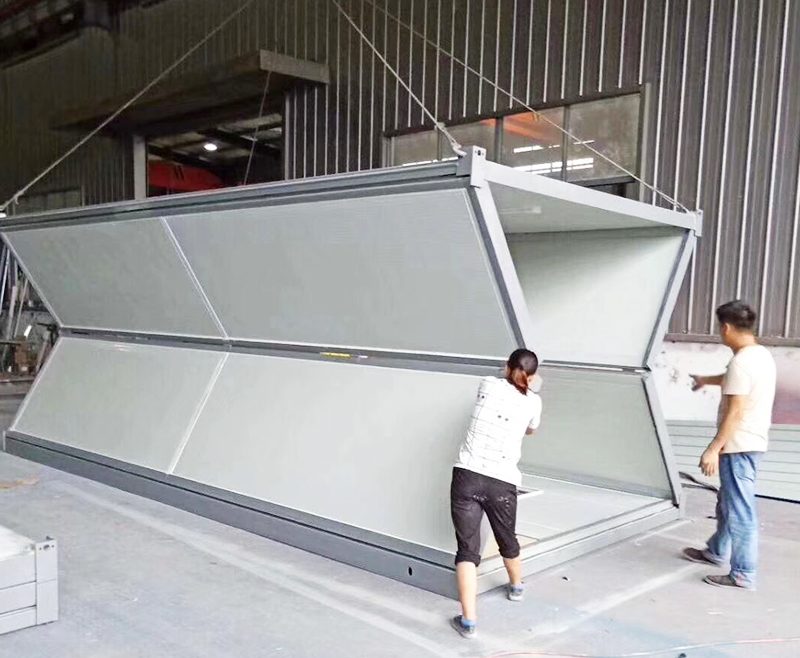
Understanding why it's popular is a prerequisite for understanding its disadvantages.
Essentially,foldable container houses are a highly modular form of construction.Its greatest value lies not in how luxurious the living space is,but in its extremely high deployment efficiency.
When a project is sensitive to time,transportation costs,and on-site construction conditions,this solution that can"compress transportation volume and reduce on-site work"will naturally be given priority.
In many scenarios,what users truly care about is not whether the living experience is close to that of a traditional house,but:
Can it be put into use as soon as possible?
Is the budget controllable?
Is the process sufficiently predictable?
It is against this backdrop of demand that foldable container houses have been widely adopted and are attracting increasing attention.
But problems have also arisen.
When a product is constantly emphasized for its"efficiency"and"cost-effectiveness,"it often means that compromises have been made in other areas.
This is a problem that many people don't pay much attention to initially,but it's the easiest problem to magnify later on.
The reason why foldable container houses can be folded is essentially through hinges,connectors,and movable joints to complete the unfolding and folding.This structural logic is fundamentally different from traditional container houses with overall welded structures.In practical use,these differences are mainly reflected in:
Limited load-bearing capacity
Overall rigidity is inferior to integrated structures
More sensitive to foundations and fixing methods
Especially when the project involves multi-story stacking,long-term fixed use,or has specific requirements for wind resistance and seismic resistance,this structural difference becomes increasingly apparent.
To put it simply:it is more suitable to be used as a"movable building unit"rather than a permanent building that remains stationary for a long time.
Much of the user feedback focuses on the"living experience."
The folding structure means that the walls are not completely integrated,but have multiple joints,movable parts,and expandable sections.These locations are often where insulation and sealing are most easily compromised.
In areas with relatively mild climates,this problem may not be very noticeable.However,if your environment has large temperature differences,such as cold or hot regions,the problems will gradually become apparent:
Indoor temperature is not stable enough
Increased frequency of air conditioning or heating use
Sound insulation effect is not as good as expected
In many cases,it's not that it's"uninhabitable,"but rather that living in it is not comfortable.
From a structural point of view,the true"core components"of a foldable container house are not just the steel structure itself.
Those parts you usually don't pay much attention to,such as hinges,slides,and movable connection points,are the key to determining its long-term condition.And these components are inherently wear-prone parts.
If the project requires frequent disassembly and reassembly,the wear rate of these parts will be significantly faster than that of ordinary modular buildings.Accordingly,the maintenance frequency and maintenance costs will also increase.
This is why many experienced users try to avoid repeated folding and choose to unfold it once and use it for a long period in stages.
From the appearance,foldable container houses are usually very regular,giving a feeling of"high standardization."
But standardization often means limitations.The folding logic largely determines the container's proportions and unfolding method,which leads to:
Limited size adjustment options
Little variation in internal layout
Higher difficulty in personalized design
If your project requires a high degree of customization,such as non-standard sizes,complex functional divisions,or specific design requirements for the appearance,then a foldable solution is often not the most flexible option.
This is a point that many people tend to overlook during the budgeting phase.
In terms of the price per unit,foldable container houses are usually not cheaper than flat-pack container houses.Their advantages are more evident at the overall project level,rather than in the unit price.
In other words,its cost-effectiveness highly depends on:
Transportation distance
Installation labor costs
The project's requirements for deployment speed
If your project is not urgent and local transportation and labor costs are relatively controllable,then this advantage may be significantly reduced.
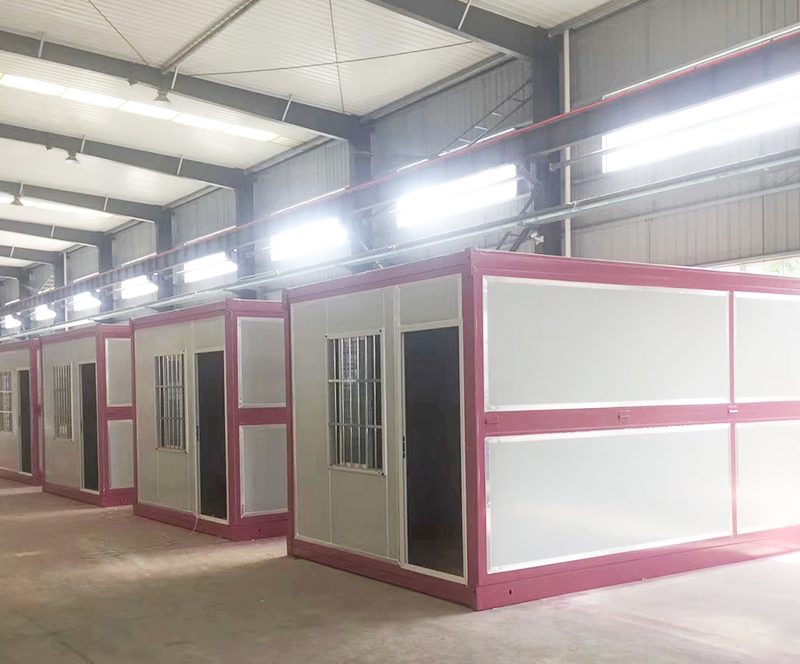
At this point,it's important to emphasize that discussing these disadvantages is not to negate foldable container houses.
In fact,most problems are not about"whether they exist,"but whether they will become real problems in your project.
If you use a foldable container house as a permanent residence,its shortcomings will be very obvious;
However,if your usage logic matches its product positioning,then many problems can be effectively mitigated.
The key is not the product itself,but how you choose,configure,and use it.
In many projects,structural stability is not a question of"whether it's sufficient,"but whether it has been taken seriously.
During the procurement phase,you can already make a first-round judgment.For example,whether the thickness of the steel structure itself is sufficient,whether the folding joints have additional reinforcement designs,and whether it supports ground anchoring or secondary fixing after unfolding.These details will directly affect the later use.
For projects with medium-to-short-term fixed use,as long as it is properly fixed after unfolding and combined with simple foundation treatment,the overall stability will often be significantly improved.
It may still not be as stable as a fully welded structure,but it is sufficient for most practical use scenarios.
Many people have a low opinion of the"living experience"in foldable container houses,but this isn't entirely due to the structure itself,but rather the choice of configurations.
Insulation and soundproofing depend less on whether the structure is"foldable"and more on the type of enclosure system used.
Thicker sandwich panels,more reliable sealing methods,and adding an independent insulation layer in extreme weather conditions will directly improve the indoor experience.
When the configuration is constantly being downgraded to cut costs,comfort will naturally be affected;but as long as the standards are reasonable,the foldable structure itself will not necessarily lead to a"poor living experience."
One easily overlooked fact is:
Foldable does not equal repeated folding.
If your project doesn't require frequent relocation,you can unfold it once at the beginning,use it as a fixed structure afterward,and perform simple regular inspections and maintenance.This will significantly reduce the wear and tear on hinges and connecting parts,and extend the overall service life.
In actual projects,many cases with longer usage cycles have adopted this approach,rather than constantly disassembling and reassembling the structure.
The space in a single foldable container house is indeed limited,that's a fact.But the problem is that many projects try to cram all functions into a single unit from the start.
If you change your thinking and separate different functions into multiple modules,such as using different units for accommodation,office,and sanitation,and then combine them through a reasonable layout,the overall space experience will often be much better.
This approach doesn't increase structural complexity,but it significantly improves flexibility in use and is more consistent with the logic of modular construction itself.
When discussing price,the cost of a single unit is not the most important indicator.
If you are dealing with a project with long transportation distances,high labor costs,and strict deadlines,then transportation efficiency,installation speed,and deployment certainty are often more critical than the price per unit.
In this case,even if the unit price is slightly higher,the advantages of foldable container houses in terms of overall project cost are still valid.The real question you need to consider isn't"which is cheaper,"but rather:
Under what circumstances might a foldable container house not be suitable for you?
At this point,a clear pattern emerges:foldable container houses themselves are neither"right"nor"wrong";the only question is whether they suit your intended use.
If your project has any of the following clear prerequisites from the outset,it's necessary to think a step further before making a decision.
If your plan involves:
Long-term residence,with a usage period of
10 years or even longer
Requirements for sound insulation,thermal insulation,and comfort close to residential standards
The need for highly customized structures or appearances
The project location already has mature construction and transportation conditions
Another common situation is when the project location has mature construction conditions,short transportation distances,and controllable labor costs.Under these circumstances,the advantages of foldable solutions in transportation and installation are significantly weakened,and the overall cost-effectiveness needs to be recalculated.
In these scenarios,traditional container houses or customized modular buildings may be more suitable options.
If we had to summarize it in one sentence,foldable container houses are not a"one-size-fits-all solution."
However,under the right conditions,they are indeed a very efficient and relatively low-risk solution.
Many controversies don't actually revolve around the product itself,but stem from a mismatch in usage expectations.When you demand that it function as a permanent residence,its shortcomings are magnified;but when you place it back in the context of"rapid deployment,temporary use,and mobile space,"its advantages become very clear.
What's truly important isn't whether it has shortcomings,but whether these shortcomings will directly affect your core needs.
If the answer is no,then it remains a worthwhile option to consider seriously.
WZHhouse is a professional container house manufacturer from China,specializing in the design and manufacturing of foldable and expandable container houses.Their products are widely used in residential,vacation homes,temporary offices,camp facilities,and commercial spaces,and are exported to many countries and regions.WZHhouse expandable container houses offer significant advantages in structural design,user experience,and delivery efficiency:
Foldable for transport,significantly reducing logistics costs
Expandable containers can be completely folded during transportation,significantly reducing transportation volume compared to traditional container houses.
For overseas customers,this means lower shipping costs and higher container loading efficiency,making it particularly suitable for bulk purchases and long-distance transportation.
Ready to use upon arrival,high installation efficiency
Once the house arrives on-site,it can be put into use after simply unfolding and securing it,without complex construction.
Installation can usually be completed within a few hours,making it ideal for projects with tight deadlines,such as temporary housing,camp dormitories,or emergency use.
High space utilization,providing a living experience closer to traditional houses
When unfolded,the interior space can reach 2-3 times the volume of the original container,with a more reasonable layout.
It can easily accommodate bedrooms,living rooms,kitchens,and bathrooms,offering significantly better comfort than ordinary container houses or prefabricated houses.
Stable structure,suitable for long-term use
WZHhouse expandable containers use a steel structure frame and high-quality sandwich panels,providing good wind resistance,seismic resistance,and weather resistance.
It is not only suitable for temporary projects but can also be used stably as a medium-to-long-term residence or functional building.
Complete amenities,supporting customization
The houses can be pre-installed with electrical circuits,plumbing,lighting,doors and windows,and bathroom systems,and can be customized according to project needs.
Whether for vacation homes,office spaces,or family use,the internal functions can be flexibly adjusted.
Returning to the initial question:What are the disadvantages of foldable container houses?The answer is actually not complicated.Due to the structural form and design logic of expandable container houses,there are indeed certain limitations in terms of comfort and service life.However,it's important to note that this doesn't mean they are unusable,but rather that they are suitable for specific applications.
If you are looking for a suitable expandable container house,you must first strictly control the quality,which can help you solve many potential problems.WZHhouse container houses provide you with the safest and most comfortable living solutions with high-quality products.



Copyright © Hebei Weizhengheng Modular House Technology Co., Ltd. All Rights Reserved
Sitemap

 +8615081877521
 +8615081877521