- icy@wzhgroup.com
- +86 15081877521


If you're planning to build a new house,you might have learned that,in addition to the standard brick structure,there are two other types of houses on the market:steel structure and wood structure.These two types of houses are very popular in certain regions.
Many people are unfamiliar with the differences between wood and steel structures.Below,WZHhouse will compare and analyze wood and steel structure houses from various perspectives,including cost,construction time,and living comfort.You can then make a more informed decision based on your needs.
Before truly comparing steel and wood structures,many people have similar questions:
Are there really such big differences between these two types of houses?Is it just the materials that are different?
In fact,the type of structure not only affects the construction method but also directly relates to the stability of the house,maintenance costs,and even the living experience for decades to come.Understanding their basic composition and structural logic will help you avoid many detours in the subsequent comparison.
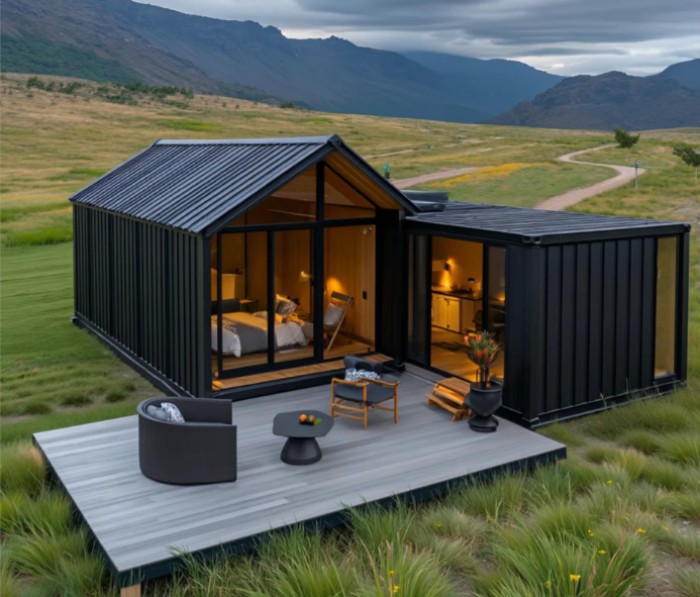
A steel structure house is a building form that uses steel as the main load-bearing system.The weight of the entire house and external loads are mainly transmitted through steel beams,steel columns,and connecting nodes,while the walls primarily serve as enclosure and partition functions.
In actual projects,most steel structural components are cut,welded,and treated with anti-corrosion treatment in the factory before being transported to the site for assembly.This"factory prefabrication+on-site assembly"method makes steel structure houses very stable in terms of dimensional accuracy and construction efficiency.For example,for common residential or small buildings,the construction time for the main steel structure can usually be shortened by 30%–50%compared to traditional cast-in-place methods.
From a material performance perspective,steel has very high tensile and compressive strength.For example,the yield strength of common structural steel is usually between 235–355 MPa,which is a key reason why steel structures can easily achieve large spans and reduce the number of load-bearing walls indoors.For many homeowners,this means more flexibility in later layout adjustments or space utilization.
From the user's perspective,steel structure houses are more suitable for projects that have specific requirements for structural safety,seismic performance,and construction time.For example,commercial uses,modular housing,or building projects that need to be completed quickly.However,it's important to note that steel conducts heat quickly,and if insulation and fire protection designs are inadequate,the living comfort will be affected.
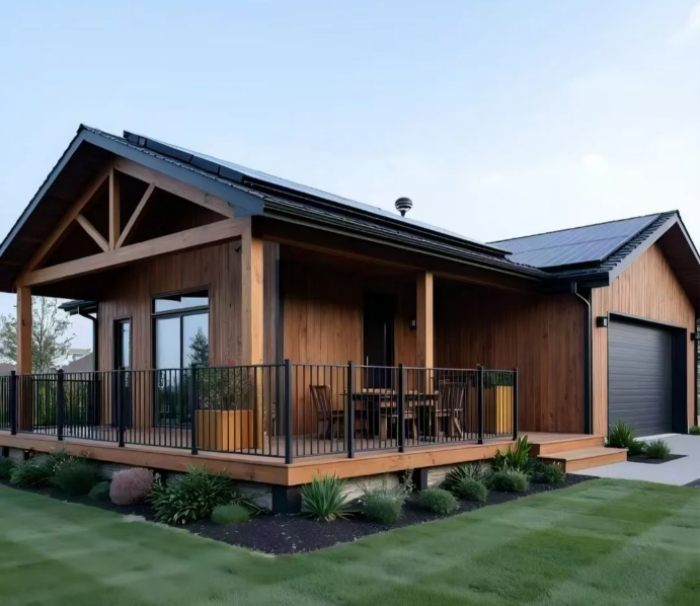
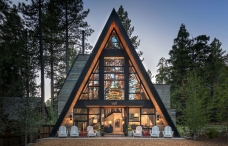
Wood-frame houses use wood as the main load-bearing material,supporting the entire building through beams,columns,or lightweight frame systems.Common forms include traditional solid wood structures,as well as lightweight wood structures widely used in North America and Northern Europe(such as 2×4 and 2×6 systems).
Globally,wood-frame houses are not a"niche choice."For example,in the United States,over 90%of single-family homes use wood structures,and a considerable number of these houses have been in use for over 50 years.This also demonstrates that,with proper design and maintenance,wood structures do not equate to a short lifespan.
In terms of structural performance,although wood is not as strong as steel,it is lighter and more elastic.Under the same conditions,the self-weight of a wood-frame house is usually only 1/3–1/5 of that of a steel structure,which means it experiences relatively less inertial force during an earthquake.For this reason,many earthquake-prone countries still widely use wood-frame houses.
From the perspective of living experience,wood itself has good insulation and humidity control capabilities.Research data shows that,under the same insulation design conditions,the indoor temperature fluctuations in wood-frame buildings are usually smaller,resulting in a more stable living experience.For residents,this difference is often not noticeable on the first day,but gradually becomes apparent over time.
Of course,wood structures are not without limitations.Moisture resistance,insect resistance,and fire protection are unavoidable topics,and if maintenance is inadequate,the user experience may be significantly compromised.Therefore,wood structures are more suitable for families or projects willing to invest a certain amount of maintenance effort for living comfort.
When deciding on a house structure,the first question most people think of is almost always the same:"Which one is cheaper?"
But after truly understanding the options,many people find that the cost of building a house is not simply a matter of"steel structures are expensive,wood structures are cheap."Material prices,labor costs,construction methods,and even local building codes can all lead to significant differences in the final budget.
To determine which structure is more suitable for your budget,the key is not to look at a single price,but to break down the costs.
The cost of steel structure houses is primarily concentrated in the initial materials and processing stages.Steel itself is a highly industrialized material,and its price is usually affected by international market supply and demand and raw material prices.Therefore,price fluctuations are relatively significant in different years and regions.
In actual projects,steel structural components often need to be cut,welded,and treated for rust and corrosion prevention in the factory.This processing cost is not negligible,but it is precisely this prefabrication method that allows for higher precision and smaller errors in the components.Taking common residential or small buildings as an example,the processing and transportation costs of steel structural components usually account for 25%-35%of the structural cost.
Overall,in most regions,the initial construction cost of steel structure houses is usually 10%-30%higher than that of ordinary wood structures.However,as the building area increases and the structure becomes more complex,the unit area cost of steel structures gradually decreases.This is one of the reasons why large buildings or commercial projects tend to choose steel structures.
From the owner's perspective,steel structure is more like a choice with**"slightly higher initial investment,but greater certainty."**
In contrast,the cost structure of wood structure houses is more dispersed and more easily affected by specific configurations.The price of ordinary structural timber is relatively stable,the processing difficulty is low,and the construction tools are simple,which often gives wood structures an advantage in labor costs.
In many residential projects,the on-site construction cost of wood structures is usually lower than that of steel structures,especially in areas with abundant labor resources and experienced carpenters,this difference will be even more significant.
However,it should be noted that the"cheapness"of wood structures is often based on the use of ordinary materials and basic configurations.Once high-grade structural timber,imported timber,or higher requirements for anti-corrosion,insect-proof,and fire-resistant properties are selected,the overall cost can easily be driven up.In some high-end residential projects,the actual construction cost of wood structures may even be close to or slightly higher than that of steel structures.
From the user's perspective,the cost advantage of wood structures is more reflected in small and medium-sized residential projects with low standardization.
Cost Comparison Summary
| Item | Steel Structure | Wood Structure |
|---|---|---|
| Initial Material Costs | Higher | Lower or Medium |
| Processing and Prefabrication Costs | High | Lower |
| Labor Costs | Lower (Assembly-based) | Higher (Dependent on worker experience) |
| Long-Term Maintenance Costs | Medium | Medium to High |
| Impact of Building Scale | The larger the building scale, the more obvious the cost advantage | The larger the building scale, the more significant the cost increase |
Besides the cost,the construction time is also a major concern for many people.Especially in temporary buildings,vacation homes,or commercial projects,the construction period often directly affects usage and return on investment.In this respect,the differences between steel and wood structures are quite significant.
Steel structure houses usually adopt a"factory prefabrication+on-site assembly"method.Most components are prepared before arriving on site,and on-site construction mainly involves installation and connection.
Under ideal conditions,the construction time for the main structure of a steel building can usually be shortened by 30%-50%compared to traditional methods.For projects with simple structures,the main structure can even be completed in a few days.
The advantage of this construction method is that the pace is controllable and less affected by weather,making it very suitable for projects with clear deadlines and a desire for quick completion.
Wood structures are more inclined towards on-site construction,with a flexible construction process and ample room for adjustment,but it also requires more experience from the construction workers.
Under good weather conditions and with an experienced construction team,the construction efficiency of wood structures is not low.However,in the rainy season or in high-humidity environments,the construction pace often needs to be slowed down to avoid material dampness or deformation.
From a controllability perspective,wood structures rely more on"people,"while steel structures rely more on"processes."
Many people don't pay much attention to maintenance issues at the initial stage of building a house,but after living in it for a few years,the importance of structural durability gradually becomes apparent.
After all,a house is not a short-term product.
Steel has a significant strength advantage,performing stably in wind and earthquake resistance,and is also completely unaffected by pests.Under normal use conditions,steel structures are not prone to significant deformation or cracking.
However,steel structures are not"maintenance-free."Corrosion and high temperatures are the main hidden dangers.If anti-corrosion or fire protection treatment is inadequate,problems may still arise during long-term use.Therefore,steel structures are more suitable for projects where standards are met during the construction phase.
The lifespan of wood structures is highly dependent on materials and craftsmanship.Structural timber that has been properly treated against rot and insects can last 30–50 years or even longer under normal use.
The natural elasticity of wood gives it an advantage in handling vibrations and displacements.However,damp environments and insect infestations remain issues that require long-term attention.
From a maintenance perspective,wood structures are more suitable for owners willing to perform regular inspections and maintenance.
Many people only realize after moving in that the"comfort"of a house is closely related to its structure.
This difference is further amplified in regions with significant climate variations.
Steel conducts heat quickly;if the insulation design is inadequate,indoor temperature fluctuations will be more noticeable.It heats up quickly in the summer and loses heat quickly in the winter.
Therefore,steel-framed houses almost always require a complete insulation system;otherwise,the living experience can easily be compromised.
Wood itself has good thermal insulation and humidity control properties,resulting in relatively slow indoor temperature changes and a more stable feel.This is one of the reasons why many vacation homes,rural houses,and long-term residences prefer wood structures.
Ultimately,there is no single best structure,only the choice that best suits your project needs.
Usage Needs & Recommended Structure
| Usage Needs / Scenario | Recommended Structure |
|---|---|
| Fast Construction | Steel Structure |
| High Seismic Resistance Requirements | Steel Structure |
| Vacation Home / Guesthouse | Wood Structure |
| Long-Term Residence | Wood Structure |
| Industrial or Commercial Use | Steel Structure |
| Environmental Friendliness Priority | Wood Structure |
The last often overlooked issue is local building regulations and foundation conditions.
Different regions have different requirements for seismic resistance levels,fire safety codes,and building height,all of which directly affect structural choices and costs.
In addition,different structures have different foundation requirements,and this cost is often underestimated in the early stages.
Choosing between steel and wood structures is essentially a trade-off.If you prioritize construction efficiency,structural strength,and controllability,steel structures are more suitable.
If you value living comfort,a natural feel,and long-term experience,wood structures are often more preferable.
The truly ideal decision-making process involves considering project purpose,budget constraints,local climate,and regulations comprehensively,rather than simply following trends.



Copyright © Hebei Weizhengheng Modular House Technology Co., Ltd. All Rights Reserved
Sitemap

 +8615081877521
 +8615081877521