- icy@wzhgroup.com
- +86 15081877521


If you are sourcing mobile container houses for an overseas project,the price for a basic,factory-direct unit in 2026 might start at approximately US$1,500–US$5,000.However,units featuring full bathrooms,kitchens,air conditioning,furniture,or high levels of customization could range from US$5,000 to US$15,000 or more.
Yet,if you are planning a commercial project,the factory quote does not equate to the final project cost.Expenses such as ocean freight,destination port charges,import duties and taxes,inland transportation,foundation work,on-site installation,and utility connections may all be added to the final budget.
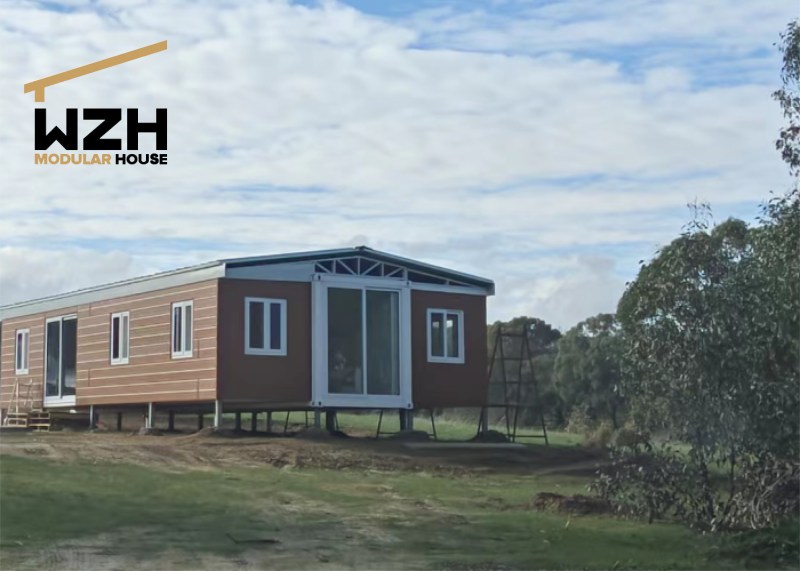
There is no single,fixed price for mobile container houses that applies to every project.For B2B projects,a more practical approach is to first determine the product type,then consider the specifications and delivery terms.
Taking export quotes from Chinese mobile container house factories as an example,open market data from 2026 indicates that the FOB price for a standard 20ft flat-pack container house might range from US$800 to US$2,500;foldable units range from US$1,500 to US$4,000;and expandable units can reach US$2,500 to US$6,000.Prices for higher-specification 40ft units would be even higher.
Flat-pack container houses range from approximately US$1,000 to US$4,800,while expandable units range from US$4,800 to US$9,500.These are merely public ex-factory quotes and do not necessarily represent the final transaction price.
If your project requires full residential functionality,the price will differ significantly.Features such as bathrooms,kitchens,water heaters,air conditioning,furniture,high-grade insulation materials,and custom doors and windows will increase manufacturing costs.For overseas commercial projects,the true basis for comparison is not the lowest unit price offered by a manufacturer,but rather a comprehensive quote based on identical specifications.
Mobile Container House Type | Reference Factory Price* | Common Uses |
Basic Flat Pack Unit | US$800–US$2,500 | Construction site dormitories, camps, offices |
Folding Container House | US$1,500–US$4,000 | Temporary accommodation, rapid deployment projects |
Expandable Container House | US$2,500–US$6,000+ | Accommodation, offices, commercial spaces |
Fully Equipped Unit | US$5,000–US$15,000+ | Residential, camps, vacation homes, commercial projects |
*The figures above represent a reference range based on 2026 open market data;actual prices vary depending on specifications,quantity,configuration,destination,and trade terms.
To understand the cost of a mobile container house,you cannot look at product dimensions alone.The price is typically determined by a combination of structure,configuration,quantity,and shipping method.The factors below essentially determine why your final quote might be US$3,000,US$5,000,or over US$10,000.
Size is the most direct factor affecting price.For standard products,a basic 20ft mobile container house might cost around US$800–US$2,500,whereas the base price for a 40ft unit is usually higher due to the increased amount of steel,wall panels,flooring,and the larger surface area for doors and windows.
However,the price does not increase in direct proportion to the floor area.Even a smaller 20ft unit requires essential components such as doors,windows,electrical systems,flooring,and walls.If a kitchen and bathroom are added,the cost of fixed fixtures will further increase.
If you require dozens or even hundreds of units,sticking to standard 20ft or 40ft specifications usually makes it easier to control the cost per unit and facilitates mass production and container loading for the manufacturer.
Structure and materials determine the base manufacturing cost of the mobile container house.Variations in specifications for the steel frame,flooring,wall panels,insulation,and roofing systems can lead to significant differences in price quotes.For instance,regarding 20-foot units,a model featuring basic insulation and standard wall panels might cost only a few thousand dollars;however,upgrading to thicker insulation,reinforced steel structures,anti-corrosion treatments,and higher-specification roofing systems could add US$1,000–US$3,000 or more to the price.
For export projects,structural adjustments are often required to meet local wind,snow,or seismic load requirements.If you receive a higher quote,it is advisable to verify exactly which materials and structural configurations have been added to justify the cost.
Interior configuration is a major factor driving price differences.A unit with only basic flooring,wall panels,and doors/windows falls into a completely different price bracket than a mobile home equipped with a bedroom,kitchen,bathroom,and full furnishings.
In terms of actual configuration,adding a complete bathroom can increase costs by approximately US$800–US$2,000+,while kitchens,furniture,and other interior amenities will further raise the budget.The final cost depends on equipment brands,material grades,and the extent of the fit-out.
If you are purchasing units for a bulk accommodation project,standardizing the floor plan and interior configuration in advance can minimize redundant design work and production adjustments,thereby helping to control the cost per unit.
Electrical,plumbing,and HVAC systems are costs that are often overlooked.Basic models may only include simple lighting,outlets,and circuitry,whereas fully equipped homes require distribution boards,water heaters,bathroom fixtures,plumbing,and air conditioning systems.
Based on typical configurations,a basic electrical system accounts for a small portion of the cost,but adding a full bathroom,hot water system,and air conditioning can increase the per-unit budget by US$1,000–US$3,000+.
If your project is located in markets such as the US,Australia,or Europe,the units must be configured to meet local electrical standards.Informing the manufacturer of the destination country in advance helps avoid cost fluctuations caused by specification changes after the quote has been finalized.
Door and window specifications also directly impact the quote.Standard windows and entry doors are relatively inexpensive,whereas double-glazed windows,sliding doors,large floor-to-ceiling glass panels,and custom-made fixtures increase material and structural costs.Adding features such as canopies,terraces,exterior wall cladding,or shading systems can increase the price per unit by anywhere from several hundred to several thousand dollars.Projects involving accommodation or vacation homes often feature these more comprehensive configurations compared to basic models.
For B2B projects,the order quantity directly impacts the cost per unit.
For instance,if a single unit is quoted at US$5,000,an order of 10 units would cost approximately US$50,000.However,if ordering 50 or 100 units,the manufacturer can streamline steel procurement,production,and packaging based on standardized specifications,potentially further optimizing the manufacturing cost per unit.
Shipping costs are also closely linked to quantity.Certain flat-pack products can be disassembled and consolidated into a 40HQ container—fitting roughly 6–8 units—whereas larger,expandable models take up significantly more space,resulting in a lower load capacity per container.Variations in loading capacity mean that the ocean freight cost allocated to each unit will differ.
Therefore,if you require 20,50,or 100+units,it is best to specify the quantity directly to the manufacturer during the inquiry stage,rather than inquiring about a single unit first and calculating the total project cost later.
It is crucial to understand a key concept:the FOB price is not the same as the total project cost.
For instance,a manufacturer might quote US$4,000 per unit;this figure typically covers only the cost of manufacturing the product in China and delivering it to a designated port.Your actual project will likely incur additional expenses,such as ocean freight,insurance,import duties and taxes,port charges,inland transport at the destination,unloading,foundation work,and on-site assembly.
International shipping costs are not fixed,either.The ocean freight market remains subject to fluctuations in fuel prices,shipping routes,seasonality,and the international trade environment;recently,for example,quotes for 40-foot containers from China to the US have shown significant volatility.
For overseas projects,the budget can be broken down as follows:
Product Price+International Shipping+Import-related Fees+Destination Transport+Foundation+Installation+Utilities=Total Project Cost
Costs for foundations,local labor,and utility connections must be calculated based on local conditions;you cannot simply apply prices from the Chinese market.
If you are planning a commercial project,you can start by using a simple budgeting model for your estimates.
Suppose you need 20 mobile container houses with a factory quote of US$5,000 per unit;the product cost alone would be US$100,000.
Next,add expenses such as ocean freight,port and import fees,local transport,foundation work,and installation to the budget.If these additional costs total US$40,000,the preliminary budget for the entire project would be approximately US$140,000,averaging about US$7,000 per unit.
This example is intended to help you understand the cost structure rather than provide a fixed market price.In actual projects,factors such as shipping distance,taxes in the destination country,site conditions,and installation methods can cause these figures to vary significantly.
This calculation method becomes even more valuable if you are ordering 50 or 100 units.As the volume increases,you must look beyond the unit price and optimize factors such as container loading efficiency,packaging methods,shipping batches,and on-site construction scheduling.
Reducing project costs does not necessarily mean choosing the cheapest product.A more effective approach is to establish a standardized plan right from the project's inception.For instance,if you require 50 employee housing units,having 30 units follow one layout while the other 20 use a completely different one adds unnecessary complexity to design,procurement,and production management.
If the majority of the units utilize uniform dimensions,doors,windows,bathroom fixtures,and electrical configurations,manufacturers can employ a relatively stable production process.
Transportation planning should also be addressed early on.For flat-pack or foldable products,procurement strategies can be determined by working backward from the loading capacity of a standard shipping container.If a 40-foot High Cube(40HQ)container can accommodate a larger number of standardized units,a well-designed product can effectively lower the transportation cost per unit.
Regarding materials,it is not always necessary to opt for the highest-grade specifications across the board.A more rational approach is to determine specifications for insulation,doors,windows,wall panels,and equipment based on the local climate,building codes,and intended use.
When requesting quotes from multiple manufacturers,you may encounter vastly different price points.
This does not necessarily imply that any single quote is unreasonable.More often,the products being offered do not share identical specifications.
For example,one quote might cover only the steel structure,wall panels,flooring,and doors/windows,whereas another includes bathroom facilities,a kitchen,electrical systems,air conditioning,and furniture.Even if the units look similar from the outside,the cost difference can be substantial.
Trade terms also play a role.Since FOB,CIF,and DDP entail different cost components,the quoted figures cannot be directly compared side-by-side.
The most effective way to compare is to have each manufacturer provide a quote based on the exact same specifications or Bill of Quantities(BOQ).Clearly outline details such as the structure,wall panels,insulation,doors and windows,electrical systems,bathroom fixtures,furniture,packaging,quantities,and trade terms before comparing the final results.
To obtain a more accurate quote,the more comprehensive the information you provide,the better.
At a minimum,you should specify the project quantity,unit dimensions,intended use,and the destination country.If you already have floor plans,share them directly with the manufacturer;if not,specify the number of bedrooms,whether a kitchen and bathroom are required,and the approximate area of each unit.
The project location is also crucial,as electrical standards,climatic conditions,and building regulations vary by country.For instance,projects in cold regions require a focus on thermal insulation and heating,whereas those in coastal or high-wind areas demand greater attention to structural integrity and door/window systems.
If you require dozens or even hundreds of units,you should state this clearly during the inquiry stage.The production and logistics logic for bulk orders differs from that of single units;manufacturers can only provide a quote that accurately reflects the project's realities once they understand the full scope of requirements.
For commercial projects,the value of a mobile container house extends beyond the unit price alone.
A key feature is factory prefabrication.Much of the work is completed in a controlled factory environment,leaving only transport,positioning,connection,and essential installation for the site.This approach facilitates standardized management compared to methods where all work is concentrated at the project site.
Another advantage is deployment flexibility.If a project is temporary or the location might change in the future,modular buildings—which can be transported and redeployed—offer greater convenience than permanent structures.
These products are already used for construction site housing,staff dormitories,temporary offices,remote camps,commercial accommodation,and other projects requiring rapid space deployment.China's exports of prefabricated buildings have seen steady growth in recent years,reaching a value of approximately$4.3 billion in 2025,with markets spanning the US,Southeast Asia,Australia,and Western Europe.
However,determining suitability for your project requires considering local regulations,land conditions,transport logistics,and the intended duration of use.A sound project budget should account for the entire process—from the product itself to final installation—rather than focusing solely on the factory quote.
If you are planning a mobile container house project,rather than simply asking"how much does a unit cost,"it is better to provide the manufacturer with basic project details upfront.
Inform the manufacturer of the number of units required,their dimensions,the intended use case,the destination country,and any specific requirements such as kitchens,bathrooms,furniture,air conditioning,or other special features.Providing floor plans,renderings,or site information is also highly beneficial.
Quotes obtained this way will more accurately reflect actual project costs and make it easier for you to compare product specifications and delivery terms across different manufacturers.
For B2B projects,the most important factor is not the lowest unit price,but rather the overall cost,quality,and delivery method for the entire project once specifications are clearly defined.
As a professional mobile container house manufacturer in China,WZHhouse provides customized container house solutions for overseas residential,commercial,accommodation,and other projects.Whether you need a few units or a larger quantity,you can share your project requirements with our team for a more accurate quotation based on the required configuration,quantity,and destination.
Contact WZHhouse today to discuss your project and get a customized mobile container house quote.



Copyright © Hebei Weizhengheng Modular House Technology Co., Ltd. All Rights Reserved
Sitemap

 +8615081877521
 +8615081877521