- icy@wzhgroup.com
- +86 15081877521


The 40-foot shipping container home is one of the best-selling sizes on the market today.It is highly versatile and can serve a multitude of purposes—whether as a standalone"granny flat"for residential use,or configured as a small office space suitable for a team of a few people.It is also frequently utilized for campsites or vacation rentals,making it a highly popular choice for tourist accommodation.
So,exactly how many rooms and living areas can be created within the interior space of a 40-foot container?What are the typical layout options available?The following section provides a detailed overview of 40-foot container homes,allowing you to select the layout that best suits your specific needs and helps you optimize the use of your space.
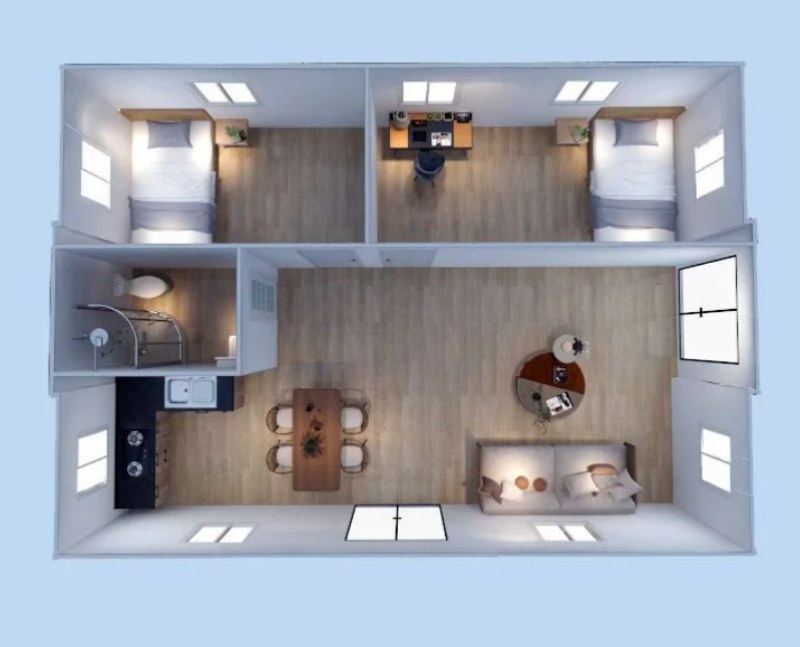
The standard dimensions of a 40-foot shipping container inherently define its spatial characteristics and layout limitations.The internal usable floor area measures approximately 28 to 30 square meters;however,space must be allocated for doors,windows,partition walls,and utility routing(such as plumbing and electrical wiring),which will inevitably consume a portion of this area.Consequently,when planning the interior room configuration,it is essential to strike a balance between ensuring smooth circulation pathways and clearly delineating functional zones.
This container size is well-suited for single occupants,small couples or families,or for use as a vacation home or studio workspace.Although the individual space is compact,its modular and expandable design opens up a world of possibilities:multiple containers can be placed side-by-side horizontally,or stacked vertically to create multi-story residences,thereby allowing for the expansion of both the number of rooms and functional areas.
The key characteristics of the interior space can be summarized as follows:
Limited Width:The internal width of 2.4 meters means that furniture should ideally be positioned flush against the walls to prevent the central walkway from becoming cluttered.
Flexible Length:The 12-meter length offers ample flexibility for distinct zoning,allowing for the clear separation of functional areas such as bedrooms,living rooms,and kitchens.
Moderate Height:The internal height of 2.6 meters is sufficient for standard residential use,though it may not be suitable for installing bunk beds or constructing extra-high storage lofts.
Once these fundamental characteristics are understood,we can proceed to design various room configurations tailored to specific requirements.
Within a 40-foot shipping container,the most common layout features one bedroom and one living area.The bedroom and living room can be separated either through an open-plan design or by using lightweight partitions,while the kitchen and bathroom are typically situated at opposite ends of the container.
Bedroom:Approximately 4–5 square meters;accommodates a 1.5-meter-wide small bed or a double bed,along with a wardrobe and storage space.
Living Room:Approximately 8–10 square meters;accommodates a small sofa,a folding table,or multi-functional furniture.
Kitchen:Approximately 3–4 square meters;features an L-shaped or linear layout designed to meet basic cooking needs.
Bathroom:Approximately 2–3 square meters;accommodates a shower,a toilet,and a washbasin.
The 40-foot,one-bedroom-and-living-room design is well-suited for single individuals or couples.It serves as a premier alternative to small urban apartments and can be utilized as a temporary residence.Many campsite owners also opt for this one-bedroom layout to serve as vacation rentals,comfortably accommodating 1 to 2 people.
For small families,a 40-foot shipping container can also be configured into a two-bedroom-and-living-room layout.Although the space in each bedroom is slightly smaller,the design remains fully functional for residential use.
Master Bedroom:Approximately 5–6 square meters;accommodates a double bed and a wardrobe.
Second Bedroom:Approximately 3–4 square meters;accommodates a single bed or a tatami-style bed.
Living Room:Approximately 6–8 square meters;doubles as a dining area.
Kitchen and Bathroom:The layout is similar to the one-bedroom option but requires a slightly more compact design.
The two-bedroom-and-living-room design for a 40-foot container home is ideal for a family of three seeking a long-term residence.While the space may feel relatively compact,a thoughtful design approach can transform it into a cozy and comfortable home suitable for extended living.
Additionally,this configuration is well-suited for use as a rental property or a shared living space.As a portable and modular structure,it is an excellent solution for both urban and suburban environments.
A single,standard 40-foot shipping container is typically too small to accommodate three separate bedrooms.However,by utilizing expansion modules or a combined layout,it is entirely possible to create a space featuring three bedrooms,a living room,and a bathroom.This usually requires adding an additional module positioned alongside the original container structure.
Master Bedroom:Approx.6 sq.m
Second Bedroom:Approx.4–5 sq.m
Third Bedroom/Multi-purpose Room:Approx.3–4 sq.m
Living Room:Approx.8 sq.m
Kitchen:4–5 sq.m
Bathroom:2–3 sq.m
The three-bedroom,one-living-room layout of a 40-foot container home is well-suited for small extended families;it also serves excellently as a vacation home,making it ideal for family travel accommodations.Furthermore,it is perfect for combining mobile office and residential functions,offering a comfortable living area alongside a dedicated workspace.
Space is limited in a 40-foot container home.To ensure a superior and more comfortable living environment,you must apply careful thought to the design process,aiming to maximize space utilization within these finite dimensions.Below are several techniques designed to enhance space efficiency.
In a confined space,multi-functional furniture is the key to enhancing living comfort.For instance,when selecting furnishings,consider beds or sofas with folding mechanisms;these can be folded away when not in use,thereby freeing up a larger area for movement and activity.
Wall-mounted storage cabinets also make full use of otherwise idle wall surfaces,providing a designated place for daily essentials without creating a cluttered appearance.
Additionally,a*tatami*-style platform design is an excellent option.The space beneath the bed platform can be designed with drawers or storage compartments to stow away clothing,books,or miscellaneous items.This approach not only keeps the living area tidy but also eliminates the need for bulky,floor-consuming storage furniture,making the entire room feel spacious and bright.
To make the overall space appear more expansive,you can adopt an open-plan interior design to avoid the claustrophobic sensation often associated with small spaces.For example,you might arrange the kitchen,dining area,and living room along a single linear axis;this layout facilitates daily living while creating a sense of spatial continuity and openness.
Incorporating movable partitions or sliding doors allows you to section off the bedrooms or office area when privacy is required,while maintaining an open and airy feel at other times.
An open-plan layout is particularly well-suited for vacation homes or temporary living quarters.By having the living room double as a dining area and connecting the kitchen directly to the communal zone,family members or friends can gather without feeling cramped,all while ensuring the convenience of daily routines.
While a 40-foot shipping container has limited width,its ample height offers a distinct advantage for utilizing vertical space.Installing overhead cabinets or shelving units above the kitchen and bedroom areas allows for the storage of infrequently used items,thereby keeping the floor space clutter-free.Whether for clothing,kitchen utensils,or books,vertical storage solutions provide a practical way to gain additional space.
It is important to note,however,that furniture should not be stacked excessively high,as this can obstruct natural light and airflow.The utilization of vertical space must strike a balance between safety and comfort,ensuring that occupants can move freely within the confined area without feeling claustrophobic.
Adequate natural lighting and effective ventilation are particularly crucial in small living spaces.Skylights,floor-to-ceiling windows,or large window panels allow sunlight to flood the interior,not only enhancing the visual aesthetics but also improving indoor air quality.A cross-ventilation design ensures continuous air circulation,keeping the interior cool and fresh even during the heat of summer.
During the design phase,windows should be strategically positioned to facilitate cross-ventilation,allowing air to flow freely from one end of the structure to the other.Even within a limited footprint,this approach creates a sense of openness—allowing the room to"breathe"—while preventing dampness or stuffiness,thereby significantly enhancing overall living comfort.
Should a household grow in size or lifestyle needs evolve,modular expansion offers a flexible and adaptable solution.By adding container modules side-by-side horizontally,one can increase the number of bedrooms or expand the living room area;alternatively,stacking modules vertically creates a two-story structure,ideal for families requiring multiple bedrooms or for shared living arrangements.Modular design also allows for customization based on specific contexts—for instance,a vacation home might prioritize spacious communal areas,whereas a primary residence would place greater emphasis on the number of bedrooms.
From the user's perspective,it is essential to clearly define specific living requirements and daily habits prior to the design process.For example,if the household frequently hosts social gatherings,priority might be given to expanding the living and dining areas;conversely,for long-term residency,a balanced allocation of space for bedrooms and storage would be more appropriate.Through this contextualized design approach,even a space with limited dimensions can effectively meet daily living needs and significantly enhance the overall residential experience.
Although the interior space of a 40-foot shipping container home is inherently limited,clever spatial planning and modular design techniques make it possible to realize a variety of layouts—ranging from a one-bedroom-and-living-room configuration to a two-bedroom-and-living-room setup,or even a three-bedroom,one-living-room,and one-bathroom arrangement.
A single container unit is well-suited for individuals,couples,or small families;for such occupants,a layout featuring one bedroom and one living room,or two bedrooms and one living room,represents the most practical and efficient design choice.Modular expansion capabilities allow the structure to accommodate the needs of a family of three or provide for multiple bedrooms.
Space optimization techniques—including the use of multi-functional furniture,open-plan layouts,vertical space utilization,and optimized natural lighting and ventilation—are key to ensuring that living in a small space remains both comfortable and efficient.
Choosing a 40-foot container home is not merely a choice for a cost-effective lifestyle;it is a manifestation of a desire for a life that is flexible,scalable,and eco-friendly.With thoughtful planning and design,it can truly become a fully functional,warm,and comfortable home.
The WZHhouse 40ft container home is a smart solution for those who need more usable living space in a compact footprint.Whether you want to create a comfortable tiny home,guest house,backyard office,vacation cabin,or rental unit,a 40ft container offers enough space to support both daily living and practical functionality.
Designed for flexibility and durability,WZHhouse container homes can be customized with different floor plans,insulation systems,interior finishes,doors,windows,and utility layouts to match your project needs.From private housing to commercial accommodation,our 40ft units are built to support a wide range of modern space solutions.
Looking for the right 40ft container home design?
Get in touch with WZHhouse today for product details,layout recommendations,and a tailored quotation.



Copyright © Hebei Weizhengheng Modular House Technology Co., Ltd. All Rights Reserved
Sitemap


 +8615081877521
 +8615081877521