- icy@wzhgroup.com
- +86 15081877521


If you are considering purchasing a folding container house for use as a construction site dormitory,temporary office,worker camp,or other modular building project,the price for a single unit in 2026 typically ranges from approximately$2,000 to over$8,000.Basic folding container house units generally cost around$2,000–$3,500,while standard models with more complete specifications range from$3,000 to$5,000.Customized units—featuring additions such as bathrooms,kitchens,air conditioning,electrical systems,furniture,or enhanced insulation—can reach prices of$5,000 to over$8,000.These figures serve primarily as a budget reference for the product itself and its basic configuration;they exclude costs such as international shipping,destination port fees,local transport,unloading,and on-site installation.
Price is determined by more than just the dimensions of the house.Factors such as the steel structure,wall panel thickness,insulation materials,doors and windows,electrical systems,interior layout,bathroom/sanitary fittings,and purchase volume all influence the final quote.If sourcing from a factory in China,you must factor in shipping,customs clearance,and local delivery costs alongside the product price to arrive at a total cost that reflects the actual project requirements.
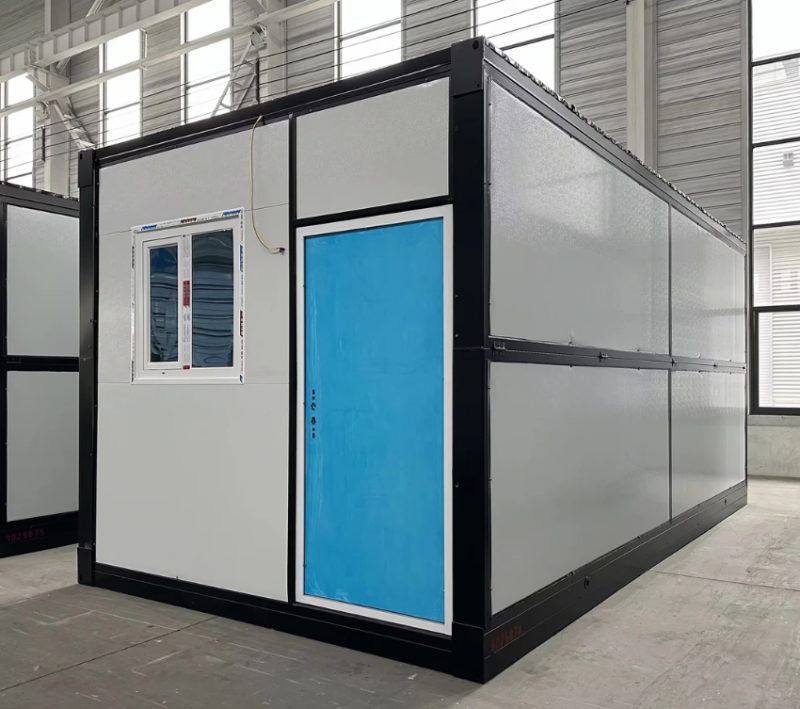
To gain a clearer understanding of 2026 pricing,it helps to compare different configurations side-by-side.The prices below are best used for initial project budgeting rather than as fixed global market rates.
| Folding Container House Type | Estimated Factory Price | Typical Configuration |
|---|---|---|
| Basic Model | $2,000–$3,500 | Basic steel frame, wall panels, roof, floor, doors, and windows |
| Standard Model | $3,000–$5,000 | Electrical system, insulation, finished flooring, and standard interior |
| Customized Model | $5,000–$8,000+ | Custom layout, bathroom, kitchen, additional doors, and electrical systems |
| High-Spec Model | $8,000+ | Enhanced insulation, HVAC, sanitary facilities, furniture, and project-specific configurations |
Different manufacturers employ varying materials and standards;consequently,quotes can differ by thousands of dollars even for products with similar external dimensions.For export projects in particular,quotes may be based on FOB,CIF,or other trade terms;therefore,one cannot determine the final cost simply by looking at the unit price of the product.
If your goal is merely to obtain a basic space that can be quickly deployed,the entry-level model can satisfy the needs of many temporary projects.Standard configurations are usually more appropriate for long-term accommodation or office use;however,if the project requires bathroom facilities,a kitchen,air conditioning,or a specialized layout,you should request a quote based on a fully equipped configuration.
When you see the price of a folding container house,the most important step is to verify exactly what the quote includes.Although they may all be described as"a container house,"some manufacturers quote prices that cover only the main structure,while others include doors,windows,electrical systems,and basic interior finishes;these cannot be directly compared.
Using 2026 market rates as a budgetary reference,a basic folding container house might cost around$2,000–$3,500,while a standard configuration typically ranges from$3,000 to$5,000.If you add features such as a bathroom,kitchen,air conditioning,high-grade insulation,or additional interior amenities,the price could reach$5,000–$8,000 or more.The following configuration elements are the primary reasons for these price differences.
The core of a folding container house lies in its steel structural frame and folding mechanism.The frame bears the structural load,while the folding mechanism determines how the product is transported and deployed on-site.
For entry-level models,the steel structure is usually included in the base price of$2,000–$3,500.If you require higher-strength steel,thicker components,a more complex folding mechanism,or structural reinforcement for a specific region,the price may increase by approximately$300–$1,000 or more,depending on the product dimensions and design specifications.
Steel specifications,component thickness,anti-corrosion treatments,and welding quality all impact costs.For long-term projects,you should look beyond the price and verify that the steel specifications,surface treatments,and structural design are suitable for local wind loads,snow loads,and the specific operating environment.
Wall panels,roofing,and flooring are also areas where significant price differences occur.Common wall designs utilize a sandwich panel structure,with core materials such as EPS,Rock Wool,or PU.Base models typically feature standard-thickness wall panels and roofing systems;however,opting for higher-grade thermal insulation or fire resistance will increase material costs.
Regarding the budget,standard wall panels,roofing,and flooring are usually included in the base product quote.Upgrading from a standard configuration to a system with superior insulation,fire resistance,or thermal protection can add approximately$300 to over$1,000 to the total price,depending on panel thickness,core material type,and roof structure.
Projects in cold regions may require thicker insulation layers,whereas projects in hot regions might prioritize roof insulation and ventilation.Rather than simply choosing the cheapest wall panels,it is best to determine the configuration based on the local climate and the intended duration of use.
Base models usually come with standard doors and windows,which are included in most basic or standard quotes.Using conventional steel doors,aluminum alloy windows,or basic uPVC windows typically does not significantly impact the overall price.
However,additional requirements—such as extra entry/exit points,fire escape doors,large windows,security doors,or custom-sized fixtures—must be calculated separately.Depending on size and material,an additional door or window unit might cost between$100 and over$500;costs will rise further if multiple doors,extensive glazing,or specialized security doors are required.
For dormitories and offices,the insulation,sealing,and natural lighting provided by doors and windows directly affect user comfort.Conversely,for construction site storage or temporary offices,unnecessary features can be omitted to allocate the budget toward more critical structural or insulation components.
The electrical system is often a key area where price differences arise between basic units and fully equipped accommodation units.
A basic electrical setup—typically comprising lights,switches,outlets,and a distribution box—is usually included in the standard quote for a folding container house(ranging from$3,000 to$5,000).Adding features such as air conditioning,electric water heaters,kitchen appliances,extra outlets,or a comprehensive interior electrical system can increase the price by approximately$500 to over$2,000.
Adding a bathroom and kitchen will significantly increase costs.For instance,a basic bathroom setup might add around$500–$1,500+,while a kitchen could add approximately$500–$2,000+,depending on the choice of cabinetry,sinks,appliances,and plumbing configurations.If you include a bathroom,kitchen,air conditioning,and furniture,the total cost typically falls within the$5,000–$8,000+range.
If you encounter a price that is significantly lower than those of other suppliers,it is best to verify whether the quote covers only the basic structure—such as the frame,wall panels,doors,and windows—without including electrical,plumbing,or interior fixtures.A price comparison is only truly meaningful when the specifications are standardized.
Size influences steel consumption,wall panel surface area,the number of doors and windows,and transportation methods;however,the price of a folding container house is not calculated simply based on floor area.
The 20ft model is a common specification suitable for single-person offices,basic accommodation,small construction site projects,and similar applications.Once unfolded,the interior space can be configured as an office,a bedroom,or a simple living unit depending on the layout.
If the configuration remains basic,the price of a 20ft model can usually be kept within a lower range.Adding a bathroom,kitchen,or separate functional zones increases the amount of internal equipment,which in turn affects the price.
The 40ft model offers more interior space,making it better suited for multi-person offices,dormitories,and projects requiring a larger usable area.
While the price is generally higher than that of the 20ft model,it does not mean the cost is simply double.Certain structural elements,doors,windows,and electrical systems can be standardized,so the specific quote depends on the chosen layout and configuration.
Size is just one factor influencing the price.
For instance,a 40ft folding container house with a basic configuration might be more cost-effective than a 20ft unit equipped with a bathroom,kitchen,air conditioning,and high-grade insulation.When requesting a quote,it is best to specify the size,layout,and functional configuration rather than providing only the floor area.
If you are sourcing from a factory in China,the product price represents only a portion of the total project cost.The final expense must also account for transport from the factory to the port,international shipping,port charges at the destination,and local delivery.
Shipment from the factory incurs costs related to domestic transport,container loading,and export procedures.Upon arrival at the destination port,expenses may include port handling,customs clearance,taxes,and local transport.Finally,the cost of transporting the unit from the port to the project site is calculated based on distance,road conditions,and the type of vehicle used.
A key advantage of the folding container house is its ability to be transported in a folded state.Compared to fully assembled units,the folded volume is smaller,saving space during transit.For projects requiring dozens or even hundreds of units,transport efficiency has a significant impact on the final cost per unit.However,one cannot simply assume that"shipping folding products is always cheaper."Actual costs depend on the folded dimensions,weight per unit,loading method,destination port,and prevailing ocean freight rates.The most accurate approach is to have the manufacturer calculate the cost based on specific quantities and the destination.
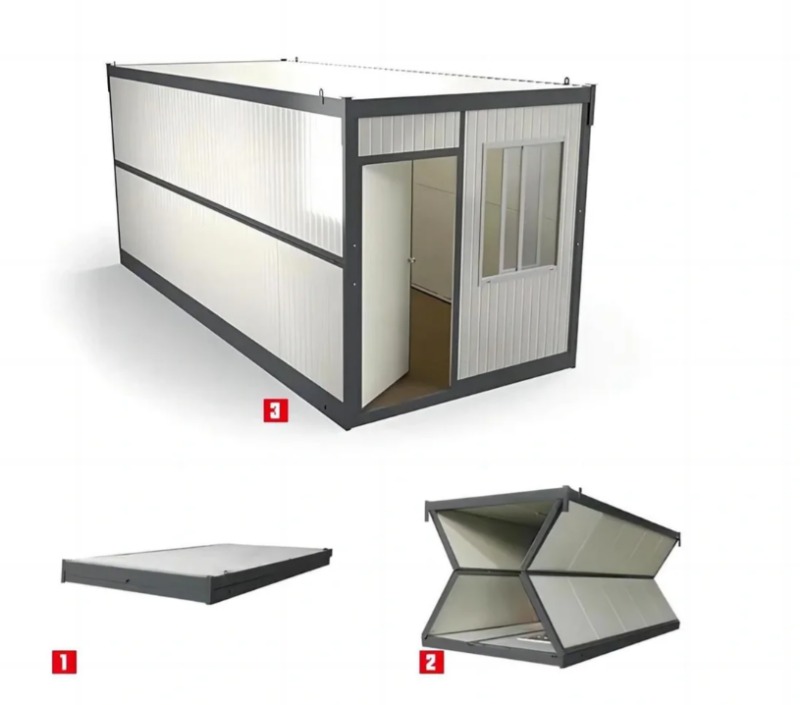
On-site installation of a folding container house is generally faster than traditional construction;however,"unfolding the house"is not the same as"completing the entire project."
Once the product arrives on-site,tasks such as positioning,unfolding,securing,and making necessary connections must be completed.If the project includes plumbing,electrical systems,bathrooms,kitchens,air conditioning,or other facilities,corresponding on-site installation and commissioning are also required.
The need for a crane depends on the product structure,unit weight,and site conditions.Some projects can be positioned using existing on-site lifting equipment,while others require a dedicated crane.Site flatness,foundation requirements,and whether transport vehicles can access the site directly will also influence the final installation cost.
For bulk projects,on-site installation efficiency is usually easier to manage than for single-unit projects.Preparing the ground,drainage,and utility connections in advance can reduce waiting times after the product arrives.
For export projects like those from WZHhouse,it is essential to clarify beforehand what technical documentation and installation guidance the manufacturer provides.If the manufacturer does not handle on-site installation,the cost of local labor and equipment should be factored into the project budget separately.
When comparing prices,you will likely encounter options other than just folding container houses.Flat-pack container houses and expandable container houses are also common choices.Prices for these three types cannot be compared in isolation without considering transportation,installation,and usage methods.
The main advantage of a folding container house is that it can be folded for transport and unfolded on-site to create a fully functional living space.In contrast,a flat-pack container house uses a knock-down structure;wall panels,frames,and other components are bundled for transport and assembled upon arrival at the site.
If a project requires large-scale transport,rapid deployment,and minimal on-site assembly work,a folding container house usually offers greater advantages.If you prioritize modular combinations,future disassembly,and flexible layouts,a flat-pack house might be more suitable.
The final choice should not be based solely on the unit price;transportation,labor,and installation time must also be factored into the calculation.
Expandable container houses offer greater interior space once unfolded,making them generally suitable for projects requiring more living area.Folding container houses,on the other hand,prioritize ease of transport and rapid deployment.
If you need site offices,dormitories,or temporary structures in large quantities,folding models often provide a straightforward solution;if you prioritize space utilization and living comfort after deployment,expandable container houses are worth considering.
For large-scale projects,the most logical approach is not simply comparing which product is cheaper,but calculating the total cost,including the product price,shipping,installation,and usable floor area.
If you require dozens or even hundreds of folding container houses,the purchase volume will significantly impact the final quote.
Mass production allows factories to standardize materials,dimensions,and manufacturing processes;it also enables centralized procurement of steel,wall panels,doors,windows,and electrical components based on project needs.Higher standardization generally makes production and packaging easier to control.
The same applies to shipping.Exporting multiple units together allows for better planning of loading and shipping schedules,reducing the extra costs associated with shipping individual units separately.
However,bulk purchasing does not automatically guarantee the same discount for every project.If each unit has different requirements for layout,bathroom facilities,electrical systems,and interior finishes,production complexity remains high.Therefore,when requesting a quote,it is best to specify the quantity and standardize product specifications as much as possible.
For large projects,you can provide the factory with the estimated quantity,intended use,and target configuration,allowing them to calculate costs based on the project as a whole,rather than simply asking for the lowest price for a single unit.
Online prices are useful for establishing a preliminary budget,but if you are ready to proceed with actual procurement,simply stating the number of folding container houses required is usually insufficient to obtain an accurate quote.
Manufacturers need to know at least the quantity,dimensions,intended use,and destination.For dormitories or offices,the room layout must be determined;if bathrooms and kitchens are required,the quantity and configuration need to be specified;and for cold or hot regions,insulation levels and air conditioning requirements must be established.
The destination is equally important.Chinese factories may quote prices based on EXW or FOB terms,or offer CIF and other trade terms depending on the project.Different pricing methods cover different costs,so you cannot simply compare two figures directly.
When requesting a quote from WZHhouse,you can provide details such as the purchase quantity,size requirements(20ft or 40ft),intended use,interior layout,bathroom and electrical specifications,and the destination country or port.Based on this information,WZHhouse can assess product specifications,production requirements,and shipping options to provide a factory quote that more accurately reflects your specific project.
How much does a Folding Container House cost in 2026?
In 2026,the factory price for a folding container house typically ranges from approximately$2,000 to over$8,000.Basic models may start around$2,000–$3,500,while standard configurations usually range from$3,000 to$5,000;units equipped with bathrooms,kitchens,air conditioning,and other custom features can reach$5,000–$8,000 or more.
How much is a 20ft Folding Container House?
The price of a 20ft folding container house varies based on the structure,wall panels,doors,windows,and interior configuration.Basic models can start around$2,000–$3,500,whereas fully equipped or customized units may reach$5,000 or more.
How much is a 40ft Folding Container House?
A 40ft folding container house is generally more expensive than a 20ft model.Basic and standard configurations may range from approximately$3,000 to$6,000;prices may increase further if features such as bathrooms,kitchens,electrical systems,furniture,or specialized insulation are added.
Does the price include shipping?
Not necessarily.You need to confirm whether the supplier's quote is based on EXW,FOB,CIF,or other trade terms.Costs for international shipping,destination port fees,customs clearance,local delivery,and unloading may need to be calculated separately.
Does a Folding Container House require a crane?
Some projects require a crane for on-site positioning,depending on the product's weight,folding structure,and site conditions.If you are planning a purchase,you can confirm the lifting equipment requirements directly with the manufacturer during the quoting stage.
Can Folding Container Houses be customized?
Yes.Common customization options include room layout,doors and windows,wall panels,insulation,electrical systems,bathrooms,kitchens,air conditioning,and furniture.Higher levels of customization may result in increased production costs and longer delivery times.
Can I buy Folding Container Houses directly from a Chinese factory?
Yes.Sourcing directly from Chinese prefabricated container home manufacturers is often ideal for bulk projects;however,you should verify the factory's production capacity,material specifications,export experience,quality control measures,packaging methods,and the technical support they offer.
In 2026,prices for Folding Container Houses start at approximately$2,000,with significant price variations depending on whether the unit is a basic model,a standard configuration,or a highly customized product.The final quote is determined not only by the size(20ft or 40ft)but also by the steel structure,wall panels,insulation,doors and windows,electrical systems,bathroom and kitchen facilities,and other interior features.
When sourcing from China,you should factor in the product price,international shipping,destination port charges,local delivery,and installation costs.For bulk projects,the order volume and the degree of product standardization will also influence the final cost per unit.
If you have already determined the project quantity,intended use,and destination,WZHhouse can provide configuration recommendations and factory quotes tailored to your specific needs.Simply provide details such as the estimated quantity,dimensions,interior layout,and required features,and we will calculate a suitable product solution and project cost for you.



Copyright © Hebei Weizhengheng Modular House Technology Co., Ltd. All Rights Reserved
Sitemap

 +8615081877521
 +8615081877521