- icy@wzhgroup.com
- +86 15081877521


If you import a container home from China to Australia with a factory price of approximately US$10,000–$20,000,you also need to set aside roughly US$3,000–$8,000+for international shipping and associated export/import fees.When you factor in inland transport from the Australian port to the project site,unloading,and potential crane rental costs,the final"landed cost"of the container home is usually significantly higher than the factory quote.
Simply put,if you are importing a container home priced at US$10,000–$20,000,you can use a rough budget range of US$13,000–$28,000+to cover the house and international import logistics,then calculate the final cost based on local Australian transport,unloading,and specific project conditions.This is merely a preliminary estimate rather than a fixed quote;the actual amount depends on the specific dimensions,weight,number of containers required,and the destination.
You can use the following formula for estimation:Total Landed Cost=Factory Price+Export Costs+Ocean Freight+Import Costs+GST/Duties+Local Delivery+Unloading.
Below,we break down the costs associated with importing a prefabricated house from China to Australia in detail;we hope this information proves helpful.
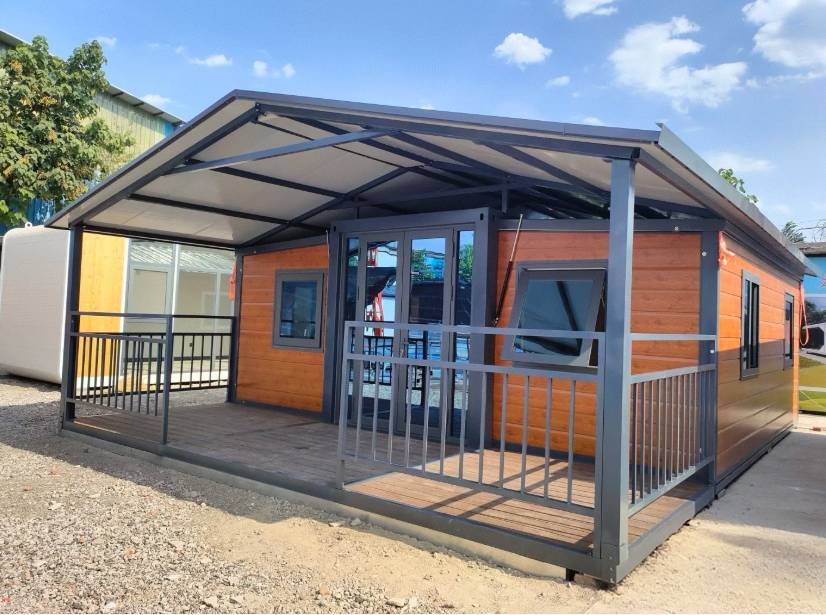
A container home from a Chinese manufacturer typically costs around US$10,000–$20,000 for an export-ready mid-range model;basic models may start at around US$10,000,while highly customized units can exceed US$20,000.
The factory price serves as the starting point for calculating import costs.Quotes provided by Chinese factories for container homes generally depend on factors such as dimensions,steel structure,wall materials,doors and windows,flooring,and interior fit-out.
Basic models may include only the structure and the essential building envelope,whereas models equipped with a kitchen,bathroom,shower,electrical wiring,plumbing,and a complete interior finish will command a significantly higher price.Taking export-oriented container homes as an example,the starting budget for a basic model is around US$10,000,while mid-range configurations may range from US$10,000 to US$20,000.If you opt for premium insulation,bathroom and kitchen facilities,furniture,appliances,or specialized structural designs,the price could exceed US$20,000.
It is important to note that the"factory price"is not the final price you will pay in Australia.
For instance,if a Chinese factory quotes US$15,000 for a container home that requires two 40HQ containers for shipping,you must also factor in the shipping costs for both containers,as well as relevant export and import fees.
Therefore,when inquiring about prices,it is best not to simply ask,"How much is the container home?"
You should also confirm:"How many shipping containers are required?What are the packed dimensions and gross weight?What is included in the factory price?"
This information directly impacts subsequent export costs and ocean freight charges.
Exporting a container home from China can add roughly US$300–$1,000+to the cost before ocean freight is even considered;this covers expenses such as inland transport(factory-to-port),loading,export documentation,and related handling fees.
Once the factory price is established,the next cost component is export costs.
These costs are incurred between the time the container home leaves the factory in China and the moment it is loaded onto the ship.They may include inland transport from the factory to the port,container loading,export documentation,customs declaration,and port handling fees.
For large container homes,the distance between the factory and the departure port affects inland transport costs.If the factory is far from the port and requires large trucks to transport multiple containers,the cost will naturally increase.
If a container home requires two 40HQ containers,the cost of transporting them from the factory to the port must be calculated based on two containers.
For an initial budget estimate,you can set aside US$300–$1,000+to cover inland transport,loading,and export-related processing within China;however,the actual cost will depend on the factory's location,the distance to the port,the number of containers,and specific export arrangements.This cost may appear lower than the ocean freight,but if the project requires multiple containers,the cumulative total can be significant.
Additionally,you need to verify the status of any wooden packaging in advance.
If the container home utilizes wooden pallets,crates,or other wooden packaging materials,they must comply with Australian biosecurity requirements.Australia's DAFF has specific regulations regarding imported wooden packaging,and such packaging may need to meet standards such as ISPM 15.
As an initial budget estimate,shipping a container home from China to Australia may cost approximately US$1,500–$4,000+per 40HQ container,though actual rates vary based on the route,destination port,season,and container quantity.
Ocean freight is often one of the most significant logistics costs in the entire import process.
Ocean freight charges for container homes are typically calculated based on the number of containers used.Specific shipping costs from China to Australia are influenced by the port of departure,destination port,container type,shipping season,and market rates,making it difficult to provide a fixed,long-term price.
For preliminary budgeting,if a container home requires one 40HQ container,you can estimate the ocean freight within the US$1,500–$4,000+range;if two 40HQ containers are required,the cost must be recalculated based on the actual container volume.
For example:
| Shipping Requirement | Example | Ocean Freight |
|---|---|---|
| 1 × 40HQ | 1 container | $1,500–$4,000+ |
| 2 × 40HQ | 2 containers | $3,000–$8,000+ |
| 3 × 40HQ | 3 containers | $4,500–$12,000+ |
These are budget estimates,not real-time quotes from shipping lines.The key factor influencing cost is shipping volume.
Suppose two factories produce container homes of the same floor area:
Factory A’s product requires two 40HQ containers;
Factory B’s product requires only one 40HQ container,thanks to folding designs and optimized packaging.
Even if Factory B’s unit price is US$1,000 higher than Factory A’s,Factory B’s final landed cost may still be lower.
Therefore,the design for international shipping is itself an integral part of cost control for container homes.
Australian import costs can add around AUD 500–$2,000+to your initial budget,depending on factors such as customs clearance,port handling,import processing,cargo value,and biosecurity requirements;GST and applicable duties should be calculated separately.
Once the container home arrives in Australia,additional import costs will be incurred.
These costs primarily cover Australian import clearance,port handling,and related processing fees.
For commercial imports meeting the relevant criteria,the Australian import process may involve charges such as customs declarations,import processing fees,customs duties,and GST.The specific amounts depend on the goods'customs classification,declared value,and applicable import regulations.
For instance,upon arrival at an Australian port,a container home typically cannot be transported directly from the wharf to the project site.Subsequent transport can only be arranged after the necessary import formalities are completed,customs and biosecurity requirements are met,and all relevant fees are paid.
Another critical factor to consider regarding container homes is the materials used.
If the product contains timber,wooden packaging,or other materials posing potential biosecurity risks,the Department of Agriculture,Fisheries and Forestry(DAFF)may conduct inspections or require treatments based on the specific circumstances.
Therefore,while you can initially budget AUD 500–$2,000+for these costs,the actual amount must be determined based on the import method,cargo value,port of entry,and quotes from customs brokers.
Imported container homes are generally subject to Australia’s 10%GST on taxable imports unless an exemption applies,while customs duties depend on the product’s tariff classification and import conditions.
GST and duties are crucial components when calculating the cost of importing into Australia.
Australia generally levies a 10%GST on eligible taxable imports.However,it is important to note that this GST is not simply calculated based on the container home's ex-factory price.Australian border authorities state that the calculation of import GST is generally based on:Customs Value+Customs Duty+Transport&Insurance to Australia,with the tax then calculated at a rate of 10%.For example,a simplified calculation looks like this:
•Customs Value:AUD 20,000
•International Freight&Insurance:AUD 3,000
•Applicable Duty:AUD 0
Then:Taxable Import Value≈AUD 23,000;GST:AUD 23,000×10%=AUD 2,300.
This example is intended to help you understand the calculation method;it does not imply that all container homes are subject to the same tax rates or customs classifications.
Whether customs duty applies,which tax rate is used,and the final basis for the GST calculation must all be confirmed based on the product's actual tariff classification,import conditions,and declaration details.
If you plan to import container homes on an ongoing basis,it is best to have an Australian customs broker verify the product details prior to production,rather than waiting to address tax issues after the goods have arrived at the port.
Transporting a container home from an Australian port to the project site can cost approximately AUD 500–$3,000+per container,with distance,container size,road conditions,and site location being the primary cost factors.
Once customs clearance at the Australian port is complete,there remains a cost that is often underestimated:local delivery.
This refers to the transport from the Australian port to your project site.If your project is located near major cities like Sydney,Melbourne,or Brisbane,the distance from the port to the site might be only a few dozen kilometers;however,if the project is in a remote area,the transport distance could span hundreds of kilometers.
For preliminary budgeting purposes,you can estimate the inland transport cost from a standard port to the project site at AUD 500–$3,000+per container.
For example,for a project requiring two 40HQ containers,if the local transport cost is AUD 1,500 per container,the total would be:AUD 1,500×2=AUD 3,000.However,the actual quote will also be influenced by factors such as road distance,truck type,container size,road restrictions,the project location,and site access conditions.
If the project site is in a remote area,additional fuel surcharges or special transport fees may also apply.
Therefore,when calculating the final cost of a container home,one must account not only for the journey from China to the Australian port but also for the transport from the Australian port to the project site.
A crane may be required to unload and position a container home.Preliminary budgeting suggests a range of AUD 500–$2,500+for standard lifting operations;however,costs can rise significantly due to larger modules,difficult site access,or long lifting distances.
Once the container home arrives at the project site,it must be unloaded from the transport vehicle and placed onto its foundation.
If the unit is transported as a complete module,lifting equipment is usually required;for foldable container homes,the unloading method depends on the product's structure and the installation plan.
There is no fixed rate for lifting services.A small module might only require a standard crane truck,whereas heavier modules or projects with limited site space may necessitate a higher-capacity mobile crane.
For initial budgeting,you can allocate AUD 500–$2,500+for unloading and lifting,though costs may increase if large cranes,long-distance lifts,or special traffic coordination are required.
Site conditions are also critical.For instance,the equipment and costs differ vastly between a scenario where a truck can directly access the foundation and one where a crane must lift the module over an existing building.
Therefore,it is best to provide the project address,site photos,road width,and the weight of the unit to a local transport or lifting company before placing an order so they can confirm the logistics plan.
For a container home priced at US$15,000 shipped in a 40HQ container,the preliminary landed-cost budget should include the US$15,000 factory price plus export fees,ocean freight,Australian import charges,GST,local delivery,and unloading;the final figure must be calculated based on the specific shipment details and destination.
By combining the costs discussed above,you can arrive at a calculation that more closely reflects the actual project budget.Assume a container home with a factory price of US$15,000.
It requires:1×40HQ container.
A simplified budget breakdown looks like this:
| Cost Item | Example Budget |
|---|---|
| Factory Price | US$15,000 |
| Export Costs | US$500 |
| Ocean Freight | US$2,500 |
| Import & Port Costs | US$1,000 |
| GST / Duties | Calculated separately |
| Local Delivery | AUD 1,500 |
| Unloading | AUD 1,000 |
GST is not fixed in this example because the calculation of Australian GST depends on factors such as the actual customs value,freight costs,and applicable duties.
If multiple containers are involved,ocean freight,port charges,and local delivery costs may increase in line with the volume.
Therefore,a meaningful budget shouldn't just focus on the US$15,000 factory price;instead,it should aggregate all costs:Factory Price+Export Costs+Ocean Freight+Import Costs+GST/Duties+Local Delivery+Unloading.
This allows you to determine the total budget required to get the container home from the factory in China to your project site in Australia.
The entire import process can be understood through the"Total Landed Cost"formula mentioned earlier.From selecting the product at the Chinese factory to its final arrival at the Australian project site,every stage incurs specific import or logistics costs.
First,determine the dimensions,configuration,and intended use of the container home.Ask the Chinese factory to provide the full factory price,packing list,shipping dimensions,and gross weight.
This information not only determines the price of the house itself but also directly impacts the number of containers required and the subsequent ocean freight costs.
Determine the number of 20ft,40ft,or 40HQ containers needed based on the container home's folded dimensions,packaging method,and weight.
Once the container quantity is confirmed,check the ocean freight rates from the Chinese port to the destination port in Australia with a freight forwarder.If a single house requires two containers for transport,the ocean freight and post-arrival transport costs in Australia must be calculated based on two containers.
Once production is complete,the factory handles packaging,container loading,and the necessary export formalities in China.
During this stage,it is crucial to ensure that packaging materials—particularly wooden pallets,crates,and other timber packaging—comply with Australian biosecurity requirements.Compliant packaging minimizes the risk of additional handling or delays upon arrival in Australia.
Upon arrival at an Australian port,the shipment must undergo import declaration and customs clearance,and satisfy all relevant tax and biosecurity requirements.
Depending on the specific product,declared value,and customs classification,costs may include GST,Customs Duty,and the Import Processing Charge.
The container can only proceed to the next stage of transport once all formalities are completed and customs release is granted.
After the shipment is cleared at the Australian port,local delivery must be arranged to transport the container to the final project site.
Transport costs depend primarily on the distance between the port and the site,the number of containers,the type of truck required,and on-site road conditions.Costs can vary significantly between urban projects and those in remote areas.
Once the container arrives at the project site,unloading is required.
If the container home is shipped as a complete module,a crane truck or mobile crane may be needed to lift the unit off the transport vehicle and place it onto the foundation.The specific equipment and costs depend on the weight of the home,the lifting distance,and the available space on-site.
The entire import process can be summarized as follows:
Factory→Export→Ocean Freight→Australian Port→Customs→Local Delivery→Unloading
Each of these steps corresponds to a specific cost component within the"Total Landed Cost"mentioned earlier.Calculating costs this way provides a figure much closer to the actual project expense,rather than relying solely on the factory's quoted price.
When importing a container home from China to Australia,the focus should not be on the price of the house alone,but on the final"Total Landed Cost."The simplest calculation method is:Total Landed Cost=Factory Price+Export Costs+Ocean Freight+Import Costs+GST/Duties+Local Delivery+Unloading.
For a container home with a factory price of approximately US$10,000–$20,000,you can initially use a range of US$13,000–$28,000+as a preliminary budget for the unit and international importation,then calculate the final cost based on local Australian transport,GST,duties,and unloading requirements.
The cost components most likely to vary include Ocean Freight,GST/Duties,Local Delivery,and Unloading.
The number of units loaded per container is a particularly significant factor,as it directly impacts international shipping,port handling,and local Australian transport costs.A design that allows for efficient folding and packaging—thereby reducing the number of shipping containers required—may offer more practical value than simply negotiating a factory price reduction of a few hundred dollars.
If you plan to import a container home from China,it is advisable to confirm the Factory Price,Packing Plan,Shipping Container Quantity,Ocean Freight,Australian Import Costs,and Local Delivery details prior to production.This ensures the figures you see reflect the true cost at the project site,rather than just a product quote applicable only at the Chinese factory.
For Chinese container home manufacturers like WZHhouse,assistance extends beyond merely supplying the structure;they can also help optimize import costs through product design,folding methods,container loading strategies,and bulk shipping solutions.



Copyright © Hebei Weizhengheng Modular House Technology Co., Ltd. All Rights Reserved
Sitemap




 +8615081877521
 +8615081877521