- icy@wzhgroup.com
- +86 15081877521


As more and more people are paying attention to modular and portable buildings,the safety of foldable container houses has become one of the first and most unavoidable questions.
Whether you plan to use it as temporary accommodation for construction sites,camp lodging,commercial space,or emergency housing,"safety"is always one of the most important factors to consider before making a decision.
This concern is actually very normal.After all,features like"foldable,""expandable,"and"quick installation"sound more like designs focused on efficiency rather than stability and durability.So,can it really be as reliable as traditional buildings?Are there any hidden dangers in case of wind and rain,long-term use,or frequent relocation?
To answer this question,we cannot just look at the appearance,nor can we simply listen to the marketing claims.Instead,we need to analyze it from multiple dimensions,including structural logic,material selection,actual use scenarios,and brand manufacturing capabilities.
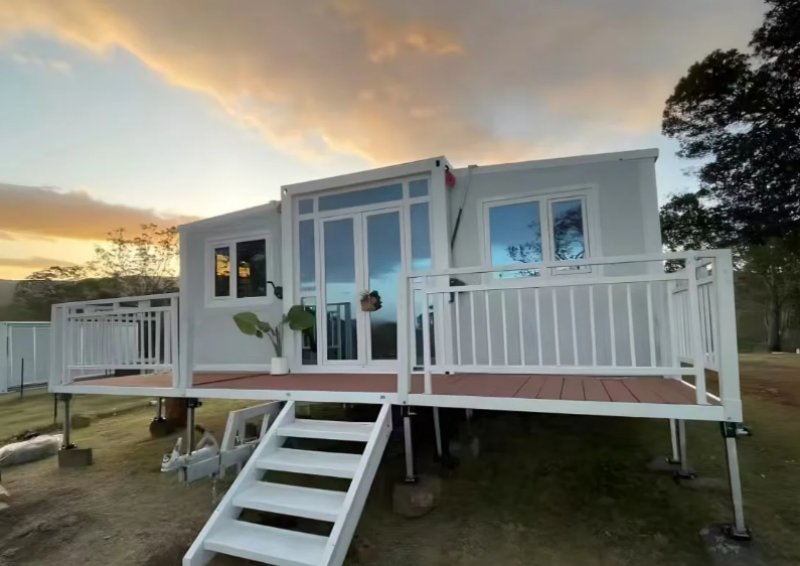
Before truly understanding the product,many users'first reaction is often hesitation or even rejection.
On the one hand,the word"folding"easily makes people associate it with temporariness,lightweight construction,and even equate it with"simple"and"unstable";on the other hand,compared to traditional concrete buildings or integrally welded container houses,the foldable structure does have more movable joints and connection points,which naturally makes people worry about whether the strength will be weakened.
In addition,the quality of products on the market varies.The cost-cutting in materials,structure,and craftsmanship of some low-priced foldable houses has further exacerbated users'misconceptions about this category.
However,in fact,truly mature foldable container houses do not sacrifice safety for convenience,but rather achieve a balance between efficiency and safety through engineering design.
The first step in understanding the safety of foldable container houses is to distinguish between"transportation state"and"use state."
During transportation,the house is folded and compressed to reduce volume and transportation costs;
After installation,it is fully unfolded and forms a stable spatial unit through a locking system.
At this point,its load-bearing logic is essentially no different from ordinary steel structure modular buildings.Roof loads,lateral wind loads,and self-weight are all evenly distributed to the ground through columns and beams,rather than concentrated on a single folding joint.
In other words,the folding structure in its deployed state is not a"movable joint,"but rather a"fixed structural connection point."
As long as the locking structure is strong enough and the joint design is reasonable,the folding itself will not weaken safety.
If structural design determines the logic of safety,then the material itself determines the lower limit of safety.
In mature folding container house products,the main frame usually uses high-strength structural steel,commonly Q235B or Q345 grade steel.This type of steel is widely used in the construction industry,and its characteristic is not that it is"expensive,"but that it has stable performance and predictable strength.
Taking Q235B steel as an example:
Yield strength is approximately 235 MPa
It has good ductility and is not prone to brittle fracture when subjected to external forces.
Suitable for repeated stress and transportation environments.
The walls and roof mostly use sandwich panel structures.The key here is not"lightness,"but achieving a balance of stability,thermal insulation,and fire resistance while ensuring controllable weight.
Rock wool core material can reach A-grade non-combustible material fire rating and will not produce open flames in a fire;
PU core material is more outstanding in terms of thermal insulation performance,with a thermal conductivity as low as 0.022–0.024 W/(m·K),improving living comfort while reducing structural stress changes caused by temperature differences.
These material choices are not for"looking high-end,"but to keep safety within a controllable range during long-term use.
Another common question is:Is this type of house only suitable for short-term use in mild environments?
The answer also depends on the design and manufacturing standards.
Under reasonable installation conditions,a folding container house is not simply an"iron box"placed on the ground.It is usually fixed to the ground with anchor bolts,expansion bolts,or embedded parts to improve overall wind resistance.
When properly anchored to the ground,the design wind resistance level of foldable container houses typically reaches:
Level 8–10 winds(corresponding to wind speeds of approximately 20–25 m/s)
This means that it can maintain structural stability under most common weather conditions,including strong winds and gusts.
Wind loads are distributed through the roof and columns,rather than being subjected to"overturning"forces.
In terms of waterproofing design,mature products focus on three key areas:
Roof drainage slope
Wall joints
Sealing structure of folding connections
Through multiple sealing strips and structural overlapping designs,its waterproof capability usually meets the requirements of no leakage even under continuous heavy rain,with an equivalent protection level close to the basic standards of building envelopes.
The steel structure itself is not sensitive to temperature changes.
After reasonable anti-corrosion treatment(such as hot-dip galvanizing or anti-rust coating),foldable container houses can adapt to:
High humidity
Strong sunlight
Areas with large temperature differences
This is why it is widely used in construction site camps,field projects,and emergency shelter scenarios.
In other words,it's not"barely usable,"but rather,when properly designed and used,it can adapt to a variety of outdoor environments.
For many users considering foldable containers,the real safety concerns often don't come from the external environment,but from daily use.
Is the electrical system safe?What if a fire occurs?Are there any hidden dangers in long-term occupancy?
In this respect,foldable container houses have a significant advantage.
Because the internal space is modularly designed before leaving the factory,the electrical circuits are usually pre-wired or integrated,avoiding the risks associated with privately installed wiring on site.At the same time,standardized production makes it easier to control construction quality.
In terms of fire safety,as long as materials that meet the required standards are used and regulations are followed during use(such as avoiding overloading high-power appliances),its safety is no less than other lightweight building forms.
At this point,a very clear conclusion can be drawn:
Whether a foldable container house is safe does not depend on the"folding"form itself,but on the professionalism of the brand that manufactures it.The same design concept can yield vastly different results depending on the manufacturer.
Substandard steel,simplified locking mechanisms,and non-standard welding processes can all create hidden dangers during product use.
Therefore,instead of repeatedly worrying about"is this type of house safe?",it's better to focus on choosing a container house manufacturer that truly understands structure and application scenarios.
In the practical application of foldable container houses,safety and stability are not requirements added later,but should be systematically considered from the very beginning of the design.Because of this,more and more projects are focusing on WZHhouse's foldable container solutions during the project evaluation phase.
From the product design stage,WZHhouse integrates the folding nodes into the overall structural system for unified planning,rather than treating them as separate add-on features.In the unfolded state,the folding structure becomes part of a complete load-bearing system through reinforced connections and reliable locking,ensuring structural stability even after long-term use and multiple deployments.
In terms of structural details,whether it's the reinforcement method of key nodes,the selection criteria for steel materials,or the durability design of the folding and locking system,everything is optimized around actual usage scenarios,ensuring that the product can adapt to frequent transportation,rapid deployment,and long-term outdoor use.
In terms of material selection,WZHhouse prioritizes maturity and reliability.Instead of simply pursuing cost reduction,they prefer to use industry-proven structural steel and enclosure system solutions,retaining necessary safety margins from the source.This design approach gives the product more stable and predictable performance in complex environments and under long-term use conditions.
Furthermore,WZHhouse's foldable container houses are highly integrated before leaving the factory.The structure,enclosure system,and basic functional modules are all standardized and tested in the factory,effectively reducing uncertainties during on-site installation.
For users,this means a clearer installation process,easier control of construction risks,and product performance that doesn't rely on on-site adjustments,but is built on a reproducible and verifiable manufacturing system.
It is precisely based on this systematic approach from design and materials to manufacturing processes that WZHhouse's foldable container houses maintain consistent performance in terms of safety,stability,and practical application over the long term.
If you only consider the appearance or the"foldable"feature,foldable container houses can easily be misunderstood;however,after a deeper understanding of their structural design logic,material system,and practical applications,it becomes clear that they are not a temporary solution,but a modular building solution that has been proven through engineering.
With reasonable design and standardized manufacturing,foldable container houses can achieve a balance between safety,deployment efficiency,and flexibility of use,meeting the requirements for stability and reliability in various application scenarios.
Only when safety is no longer a question that needs repeated confirmation,but becomes a fundamental premise in the design and manufacturing stages,can foldable container houses truly demonstrate their long-term value.
If you are evaluating the feasibility of foldable container houses in a specific project,or would like to learn about structural configurations and solutions for different application scenarios,please feel free to contact WZHhouse.Through clearer communication of your needs and professional advice,we can help you make more sound and sustainable choices in the early stages of your project.



Copyright © Hebei Weizhengheng Modular House Technology Co., Ltd. All Rights Reserved
Sitemap

 +8615081877521
 +8615081877521