- icy@wzhgroup.com
- +86 15081877521


For decades,farm buildings have followed a largely similar pattern.Whether it's staff dormitories,farm offices,warehouses,or sales centers,most farmers opted for brick-and-mortar,steel-framed,or timber-framed structures.
However,as agricultural practices evolve,more and more farmers are rethinking their building investments.
For modern agricultural projects,buildings not only need to meet functional requirements but also need to consider construction timelines,investment costs,future scalability,and operational efficiency.Especially against the backdrop of rising labor costs,fluctuating building material prices,and the rapid pace of agricultural project updates,traditional building models are facing new challenges.
It is in this context that container houses are gradually entering the agricultural sector and being accepted by more and more farmers.From small family farms to large agricultural parks,the application of container buildings is constantly expanding.
So,why are more and more farmers choosing container houses over traditional buildings?If you are planning a new agricultural project,the following information is worth considering.
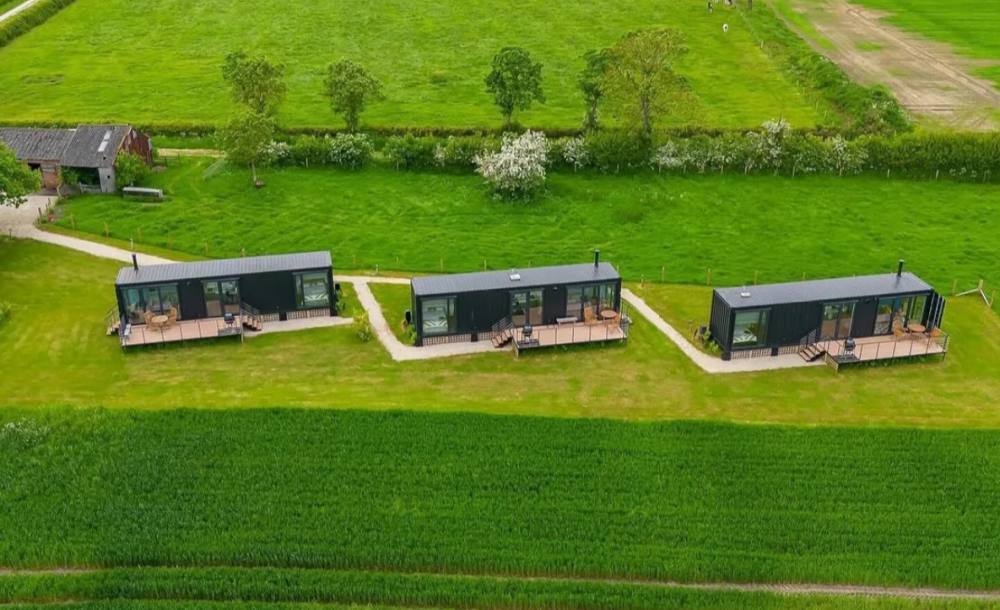
The answer is yes.Modern container houses are widely used in farms,ranches,orchards,organic farming bases,and agritourism projects.They not only meet basic building requirements but can also be customized to suit different agricultural scenarios.
Many people still associate container houses with simple freight containers.In fact,modern modular container buildings have sophisticated insulation,waterproofing,ventilation,and electrical systems,meeting long-term usage needs.
For farm operators,the most important factor is their ability to be quickly deployed and expanded according to future development needs,which perfectly aligns with the characteristics of modern agricultural projects.
Early container buildings were primarily used for temporary storage and construction site offices.
With the development of modular building technology,more and more farms are using them as long-term permanent facilities.After professional design and modification,their durability and comfort meet long-term operational requirements.
In some developed agricultural countries,container buildings have even become an important part of modern farm construction.
The Most Common Applications on Farms
Today,container houses for farms have a wide range of uses.
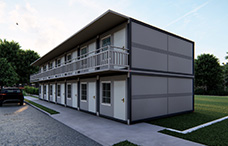
You can use them as farm offices for daily operations and management;as staff dormitories to provide accommodation for seasonal workers;or as agricultural product display centers,farm shops,equipment warehouses,and even tourist reception centers.
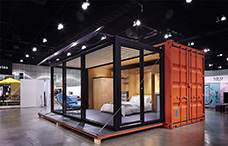
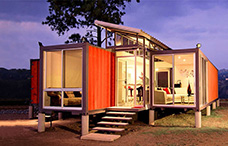
For agritourism projects,container houses can also be transformed into unique guesthouses and casual cafes,creating additional income streams for the farm.
The main reason more and more farmers are choosing container buildings is not for novelty,but for a higher return on investment and more flexible operating methods.
While traditional buildings are mature and stable,construction costs,construction cycles,and the difficulty of later modifications are constantly increasing.These problems are becoming increasingly apparent for agricultural projects that need rapid development.
In contrast,container houses can be constructed in a shorter time while retaining the possibility of future expansion and adjustments.
In recent years,the construction industry has faced the problem of continuously rising material and labor costs.
The costs of steel,cement,timber,and construction labor are all increasing.For farmers with limited budgets,building a traditional building often requires a large investment.
Especially in remote areas,the cost of construction workers and transporting building materials further increases the overall budget.
Agricultural operations are highly seasonal.
Missing the planting,harvesting,or peak tourist seasons can directly impact annual profits.Therefore,many farm projects aim to complete construction and commence operations as soon as possible.
Traditional construction,from design and approval to completion,often takes several months.Container buildings,however,have most of their production completed in a factory and can be quickly installed on-site,significantly shortening the construction cycle.
Modern agriculture is no longer simply about planting or raising livestock.
Many farms are gradually adding agricultural product sales,agritourism,family-friendly experiences,and accommodation services.Therefore,construction needs adjust accordingly to changes in business models.
Traditional construction often requires significant costs for later expansion and renovation.Modular container buildings,on the other hand,can be gradually expanded to meet actual needs,making them more adaptable to future development.
Both container houses and traditional buildings can meet farm needs,but they differ significantly in construction efficiency,investment costs,and flexibility.
For large farms seeking long-term stable operation,both solutions have their advantages.For projects seeking to control investment risk and improve construction efficiency,container construction is often more attractive.
Container Houses vs.Traditional Buildings
Container Houses vs. Traditional Buildings
Comparison Factor | Container Houses | Traditional Buildings |
Construction Cycle | Faster | Longer |
Initial Investment | Lower | Higher |
On-Site Construction | Less | More |
Expansion Flexibility | Easy | Difficult |
Mobility | Relocatable | Fixed |
Construction Waste | Less | More |
Environmental Friendliness | Higher | Average |
For many agricultural projects,time is money
Container houses are prefabricated in factories,with most production work completed in advance,allowing for installation upon arrival on-site.This significantly shortens the overall construction time.
Traditional buildings,on the other hand,require multiple stages,including foundation construction,main structure construction,and decoration,resulting in a longer construction cycle.
Farm development is often unpredictable
This year you might only need an office,but next year you might need staff dormitories and a showroom.With modular construction,you can gradually add building units as your business grows without having to demolish and rebuild.
This flexibility is difficult to achieve with many traditional buildings.
For most farms,one of the biggest advantages of container houses is their ability to reduce overall construction and operating costs.
While the purchase price of the building is an important factor,the real impact on return on investment is often the building's life-cycle cost,including construction,maintenance,expansion,and future adjustment costs.
From a long-term operational perspective,container houses can help farms save money in several ways.
Reduced on-site construction costs:Traditional buildings typically require a large on-site workforce.With container houses,most of the work is done in the factory,making on-site installation relatively simple.This means farm owners can reduce labor costs and lower on-site management costs.
Reduced future renovation costs:Many farms undergo business adjustments during their operations.If additional office space,staff dormitories,or sales areas are needed,modular buildings can directly expand with new units without large-scale demolition of existing structures.
This effectively controls future upgrade and renovation costs.
Increased building utilization:Compared to fixed buildings,container houses have greater reusability.Even if the farm changes its business direction in the future,the building can still be repurposed or even relocated to a new area for continued use,thereby increasing asset utilization.
Modern farms have increasingly diverse building needs,and one of the biggest advantages of container houses is their ability to simultaneously serve multiple purposes,including office,accommodation,storage,and commercial operations.Whether it's a small family farm or a large agricultural park,different functional spaces can be flexibly planned according to actual needs.
Compared to traditional buildings that require the construction of multiple independent facilities,modular container houses can be quickly assembled into a complete farm building system,helping farmers utilize land and capital more efficiently.
For any farm,management work is inseparable from office space.
Modern farms not only need to handle production planning but also involve employee management,order tracking,customer reception,and financial management.A fully functional container office can provide a comfortable working environment,equipped with air conditioning,lighting,network access,and meeting facilities.
Compared to traditional office buildings,container offices are faster to construct and easier to expand according to changes in farm size.
Many farms need to employ a large number of seasonal workers during planting,harvesting,or planting seasons.
Providing employees with safe and comfortable accommodation not only helps improve work efficiency but also enhances employee stability.Container dormitories can be configured with single,double,or multi-person rooms according to the number of people,and are equipped with bathrooms,air conditioning,and basic living facilities.
For farms in remote areas,this rapidly deployable accommodation solution has significant advantages.
More and more farms are starting to sell their produce directly to consumers.
By building farm shops,farmers can showcase and sell fresh fruits,vegetables,organic foods,and specialty agricultural products,thereby increasing the added value of their products.
Container shops not only have a modern appearance but can also be customized to reflect a brand image,helping farms create a more professional sales space.
Agricultural equipment is typically expensive and requires a good storage environment.
Container warehouses effectively protect agricultural machinery,tools,fertilizers,and agricultural supplies,reducing damage from wind and sun.At the same time,the steel structure itself provides high security and improves asset management efficiency.
For small and medium-sized farms,container warehouses are often one of the building projects with a high return on investment.
With the development of agritourism,more and more farms are welcoming tourists.
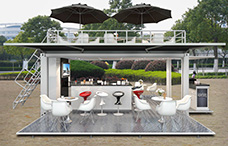
To enhance the visitor experience,many farms are building cafes,visitor centers,or leisure spaces.The unique exterior design of container buildings can attract tourist attention and create additional revenue streams for the farm.
These types of buildings are becoming increasingly common for farms looking to develop agritourism businesses.
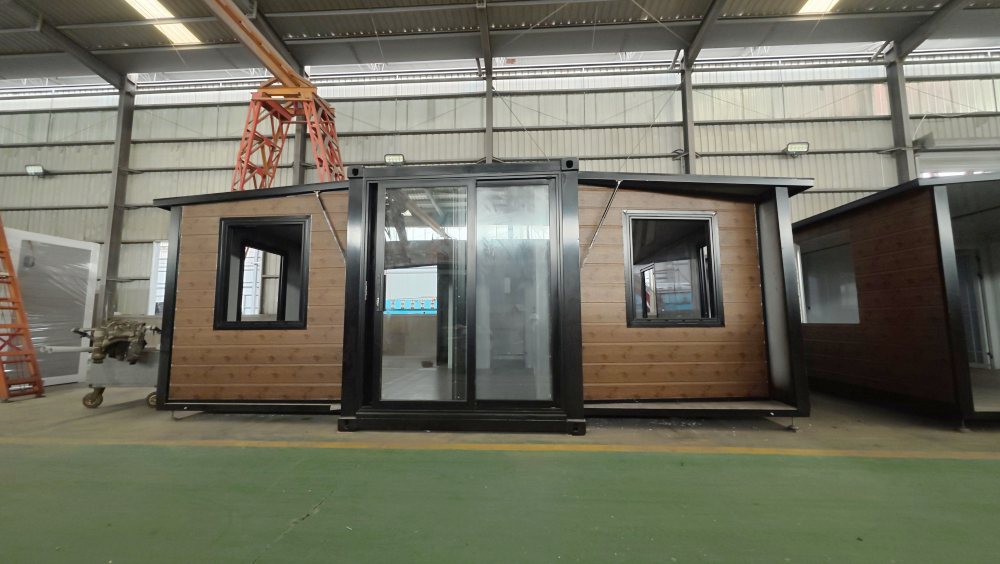
When choosing a farm container house,the most important factor is not size,but ensuring that the building meets current needs and has the capacity to adapt to future development.Planning the layout in advance during the project planning phase can often avoid unnecessary renovation costs later.
Different farms have different operating models and development directions,so the architectural plan should be adjusted according to the actual situation.
Before choosing a container house,its primary purpose must be clearly defined.
Is it for offices,staff dormitories,warehouses,or sales centers?Different uses have different requirements for building layout,internal configuration,and supporting facilities.
Only by clearly defining the functional positioning can the most suitable design scheme be selected.
Farm development is usually a gradual process.
The current need for an office doesn't preclude future additions like dormitories,warehouses,or showrooms.Therefore,expansion space should be planned in advance to prepare for future business growth.
The biggest advantage of modular construction is its ability to add new units as needed without rebuilding the entire project.
Agricultural projects are typically located outdoors,and buildings must withstand varying climatic conditions,including high temperatures,extreme cold,humidity,and strong winds.
Therefore,when choosing container houses,focus should be placed on wall insulation,roof insulation,and natural ventilation design.Good environmental control not only improves comfort but also reduces long-term energy consumption.
Not all container house suppliers understand the specific needs of agricultural projects.
Suppliers with farm project experience are generally better positioned to address employee accommodation,equipment storage,and other considerations in agricultural operations,providing solutions that better suit real-world scenarios.
When choosing a partner,it's advisable to review their past case studies and project experience.
For farm projects,choosing a reliable container house supplier is often just as important as choosing the right building scheme.An experienced team not only provides high-quality products but also helps reduce risks and costs during project implementation.
WZHhouse specializes in modular building and container house solutions,offering customized design and manufacturing services to meet the diverse needs of different agricultural projects.
Whether it's farm offices,staff dormitories,storage centers,or agritourism facilities,WZHhouse can provide personalized design solutions based on project scale and purpose,helping clients achieve higher space utilization efficiency.
Agricultural projects typically have clear construction timelines.
Leveraging a mature production system and large-scale manufacturing capabilities,WZHhouse can shorten production cycles while ensuring quality,helping projects go online faster.
As farm operations grow,building needs constantly evolve.
WZHhouse's modular solutions support later expansion and functional adjustments,allowing clients to gradually add space according to actual operational needs without large-scale demolition and reconstruction.
WZHhouse has provided modular building solutions to clients in numerous countries and regions.
Whether your project is located on a farm,ranch,agricultural park,or remote rural area,we offer a one-stop service from design and production to transportation and installation support.
Modern agriculture needs more than just a building;it needs an infrastructure solution that supports long-term development.
WZHhouse is committed to helping farmers reduce construction costs,improve operational efficiency,and create greater long-term value for agricultural projects through flexible and reliable modular construction.
More and more farmers are choosing container houses,primarily because they offer a better balance between construction speed,investment costs,and scalability.Compared to traditional buildings,modular container houses are more adaptable to the ever-changing needs of modern agriculture and help farms get up and running faster.
If you are planning farm offices,staff dormitories,storage facilities,or agritourism projects,WZHhouse can provide you with professional container building solutions.
Contact our team for free design proposals and project quotes to find the building option best suited for your farm's development.



Copyright © Hebei Weizhengheng Modular House Technology Co., Ltd. All Rights Reserved
Sitemap

 +8615081877521
 +8615081877521