- icy@wzhgroup.com
- +86 15081877521


If you are considering purchasing a 40ft expandable container house equipped with solar panels,the most immediate question is usually:how much does the whole package cost?
In reality,this question cannot be answered with a single total price.You are essentially paying for two separate components:the price of the 40ft expandable container house itself,and the cost of the solar power generation and storage system,which is configured based on your actual electricity needs.
Currently,the price of the 40ft expandable container house unit itself generally ranges from$10,000 to over$25,000.Meanwhile,solar system costs can vary from around$2,000 for a basic setup to over$20,000 for a high-capacity off-grid system.In other words,if you intend to use it merely as a weekend getaway,the total budget might be kept within the$12,000–$18,000 range;however,for long-term residence or a fully off-grid lifestyle—requiring larger solar arrays and battery storage—the total cost could reach$30,000 to over$50,000.
A frequently overlooked point is that while the"40ft"specification determines the house's dimensions,it does not directly dictate the size of the solar system.The factors that truly influence solar costs are your daily electricity consumption and whether you need to live continuously without a connection to the main power grid.
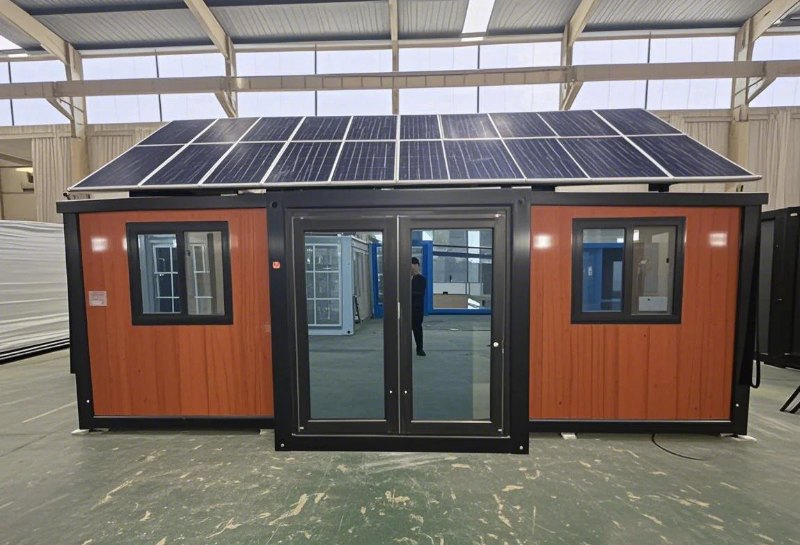
Before calculating the total price of a 40ft expandable container house with solar panels,you first need to understand the cost of the house itself.
A standard 40ft expandable container house typically features a steel structural frame;it is shipped from the factory to the project site,where it is unfolded and assembled to create a complete living space.Prices can vary significantly depending on factors such as wall insulation,doors and windows,interior finishes,kitchen and bathroom facilities,and furniture inclusions.
For a basic configuration,the price of a 40ft expandable container house is likely around$10,000–$13,000.Such units are generally suitable for projects where interior finish requirements are minimal or where the owner plans to handle further interior fit-outs independently.If you opt for a standard residential configuration—including upgraded insulated wall panels,doors and windows,bathroom and kitchen facilities,and basic electrical systems—the price typically ranges from$13,000 to$18,000.This type of setup is common for resorts,glamping sites,and short-term rental projects.
If you want a move-in-ready home—complete with furniture,kitchen appliances,bathroom fixtures,a hot water system,and premium interior finishes—the price can exceed$18,000 to$25,000.
Therefore,when comparing quotes from different manufacturers,do not focus solely on the"starting price"of a 40ft expandable container home.For instance,a quote of$12,000 from one company versus$18,000 from another does not necessarily mean the former is cheaper;the latter might already include a kitchen,bathroom,furniture,and superior insulation materials.
What truly matters is the final delivered price for the same configuration.
Unlike the house itself,there is no standard,fixed price for the solar power component.
A complete solar system comprises more than just a few panels on the roof;it includes the panels,an inverter,battery storage,mounting hardware,cabling,and protective equipment.Off-grid projects also require a backup power source.
For a 40ft expandable container home designed to power basic lighting,a refrigerator,networking equipment,and a few small appliances,a 1.5–3kW solar system is usually sufficient.Such a basic setup typically costs between$2,000 and$5,000.
If the home is intended for glamping or resort use—requiring power for lighting,a refrigerator,a TV,internet,some air conditioning,and other daily appliances—a 2–4kW system paired with a battery bank is likely needed.The total cost would range from approximately$4,000 to$8,000.
If you plan to live in the home long-term and use appliances such as air conditioners,water heaters,induction cooktops,and washing machines,your electricity consumption will increase significantly.In such a scenario,the solar system might need a capacity of 3–8 kW and a battery storage capacity of 10–20 kWh(or even higher),with a total cost likely ranging from$6,000 to over$15,000.
If the project is located in a remote area without access to the public grid and relies entirely on solar power,the configuration will typically be larger.In addition to a solar array of 5–10 kW(or more),you would need 15–30 kWh(or more)of battery storage and a necessary backup generator.A complete off-grid system like this could cost between$10,000 and over$20,000.
Consequently,the price variation for solar systems is often greater than that of the house itself.
To determine the number of solar panels required for your 40-foot expandable container home,you must first calculate your daily electricity consumption.
A simple estimation method is:
Solar system capacity≈Daily electricity consumption÷Peak sunlight hours÷Overall system efficiency
For example,if you need 10 kWh of electricity per day and your location averages 5 hours of effective peak sunlight,assuming an overall system efficiency of 80%(accounting for losses in the inverter,wiring,etc.),the calculation would be:
10÷5÷0.8=2.5 kW
This means you would need a solar power generation capacity of approximately 2.5 kW.
If using 450W solar panels,you would need to install about six of them.
However,this figure serves only as a preliminary estimate.Factors such as local sunlight hours,winter weather conditions,panel installation angle,shading,and equipment efficiency will all affect the actual power output.
Therefore,do not assume a fixed number of solar panels is required simply because the house is 40 feet long.
Consider the same 40-foot expandable container home:if used as a weekend getaway,it might only require about 5 kWh of electricity per day;conversely,for long-term living—especially with the use of air conditioning,electric water heaters,and kitchen appliances—daily consumption could reach 15–25 kWh or higher.The solar systems required for these two scenarios are on completely different scales.
If you plan to use a 40ft expandable container home as a long-term residence,the solar power system must be designed based on your actual lifestyle.
Air conditioning is typically a major source of electricity consumption in daily life.Additionally,electric water heaters,induction cooktops,ovens,washing machines,and dryers can consume significant amounts of power.If all these appliances rely on solar energy,the system capacity needs to be increased substantially.
In this scenario,a solar system in the 3–8 kW range is common,though the exact size depends on the local climate and your actual electricity usage.If you wish to continue using electricity at night,you will also need to configure a battery storage system with a capacity of approximately 10–20 kWh or even more.
For example,if your average daily consumption is 15 kWh,you can use a portion of the solar power generated during the day directly,while storing the remainder in batteries for nighttime use.If there are several consecutive days of rain and solar generation drops,the issue of insufficient battery capacity becomes more pronounced.
Therefore,if you intend to live in a 40ft expandable container home long-term,it is advisable not to simply ask the manufacturer"how many solar panels are needed."Instead,list all major electrical appliances and calculate the total power consumption based on daily usage times.
If your 40ft expandable container home is intended for a resort,glamping site,or short-term rental,the solar power requirements are usually lower than those for a long-term residence.
Occupancy periods for such units are typically limited,and electricity usage habits vary among guests.Many projects only need to support lighting,a refrigerator,hot water,Wi-Fi,a TV,and a few small appliances.
If air conditioning usage is limited or energy-efficient appliances are used,a solar system in the 2–4 kW range may suffice for some projects.Depending on battery capacity and specific equipment configuration,the budget for the entire solar system might range from approximately$4,000 to$8,000.
For resort projects,a major advantage is the ability to pre-determine the electricity usage standards for each unit.For instance,standardizing the use of energy-efficient air conditioners,LED lighting,and high-efficiency refrigerators can reduce the daily power consumption of each 40ft expandable container home.This not only allows for fewer solar panels but also lowers the required battery capacity.
If a camp consists of ten 40ft expandable container homes,the cumulative savings on equipment costs across all units become significant.
Calculating the cost of the home and the solar system together provides a clearer picture of the overall budget.
If you choose a 40ft expandable container home with a basic configuration priced at approximately$12,000 and add a basic 2kW solar system costing around$3,000,the total cost comes to about$15,000.
For glamping or resort applications,you might optfor a standard 40ft expandable container home priced at around$15,000,equipped with a 4kW solar system and battery storage;with a solar budget of approximately$7,000,the combined cost would be around$22,000.
For long-term living or off-grid housing,a higher-spec home priced at around$18,000—combined with an 8kW solar system and larger-capacity battery storage costing about$12,000—would bring the total budget to approximately$30,000.Therefore,it can be summarized as follows:
| Usage Scenario | 40ft Expandable Container Home | Solar Power System | Estimated Combined Cost |
|---|---|---|---|
| Weekend Getaway | $10,000–$13,000 | $2,000–$5,000 | $12,000–$18,000 |
| Glamping / Resort | $13,000–$18,000 | $4,000–$8,000 | $17,000–$26,000 |
| Long-term Living | $15,000–$25,000+ | $6,000–$15,000+ | $21,000–$40,000+ |
| Fully Off-grid | $18,000–$25,000+ | $10,000–$20,000+ | $28,000–$45,000+ |
These figures are intended for preliminary budgeting and do not represent final prices in every region.Costs for solar equipment,labor,import duties,and installation standards vary by country.
Battery storage,in particular,can represent a significant portion of the total solar system cost.If the home is used primarily during the day—relying heavily on direct power from solar panels—a large battery bank may not be necessary.However,if air conditioning,hot water,and other appliances need to run continuously through the night,additional energy storage capacity will be required.
If a manufacturer quotes$20,000,that does not mean the final project cost will be exactly$20,000.For 40ft expandable container homes sourced from overseas,the product quote usually represents only a portion of the total cost.
First,verify whether the quote includes international shipping.If the product is being exported from China to the US,Australia,or Europe,ocean freight costs will vary based on the destination port,shipping season,and transport method.Upon arrival,additional costs may arise for port handling,customs clearance,import duties,and local transportation.
Once the home arrives at the site,you must account for foundation construction and installation costs.Although 40ft expandable container homes can be unfolded quickly on-site,the foundation still needs to be designed according to local soil conditions,climate,and building codes.If professional installation is required,those labor costs should also be calculated in advance.
Quotes for solar panels,inverters,and batteries do not necessarily include on-site installation,electrical wiring,and system commissioning.If the project utilizes a fully off-grid power setup,a backup generator might also be required.Depending on the location,there may also be costs associated with electrical inspections,grid-tie approvals,or necessary permits.
Therefore,a comprehensive project budget can be broken down as follows:
House price+Solar power system+International shipping+Customs clearance and import fees+Local transportation+Foundation+Installation+Local permit and inspection fees
When budgeting for the project,it is best to list all these expenses upfront rather than simply comparing the factory's product quote.
The simplest approach is not to decide on the number of solar panels first,but rather to determine your daily electricity needs.
Although the dimensions of 40ft expandable container homes are standardized,usage patterns vary,meaning the required solar power systems can differ significantly.A weekend getaway home and a year-round off-grid residence will likely have vastly different power requirements.
Start by listing major appliances—such as air conditioners,refrigerators,water heaters,washing machines,induction cooktops,and lighting—and then estimate the daily usage time for each.For example,by estimating daily usage—such as 6 hours of air conditioning,2 hours of water heating,24-hour refrigerator operation,plus lighting and other appliances—you can calculate the daily electricity consumption(in kWh)and determine the required solar system capacity based on local peak sunlight hours.
If the home is for weekend getaways,a massive solar system is usually unnecessary;however,for long-term living involving frequent use of air conditioning,electric water heaters,and kitchen appliances,the system capacity needs to be significantly higher.
For resorts or"glamping"projects,overall electricity demand—and thus the need for solar panels and battery storage—can be reduced by using energy-efficient air conditioners,LED lighting,and high-efficiency appliances.
If the local area receives little sunlight in winter,the system cannot be designed based solely on summer generation figures.For true off-grid projects,you must also account for periods of continuous overcast or rainy weather and ensure sufficient battery storage capacity.
Here is a practical tip:**Improve the home's energy efficiency before increasing solar capacity.**Better insulation,high-performance windows and doors,and energy-efficient appliances can lower heating and cooling energy consumption—often a more cost-effective approach than simply adding more solar panels.
If you are preparing to request a quote from a manufacturer,avoid sending a message as brief as:
"How much is a 40ft expandable container house with solar panels?"
Such a message lacks sufficient detail for the manufacturer to provide an accurate quote.
Inform the manufacturer of the project location,the number of occupants,the intended use,and the estimated daily electricity consumption.
For long-term residences,specify whether appliances like air conditioners,electric water heaters,induction cooktops,refrigerators,and washing machines are required.For resorts or glamping projects,specify the expected daily usage duration per unit and whether battery power is needed for nighttime use.
You also need to specify whether the project is grid-tied or off-grid.Access to a stable public grid reduces reliance on large-scale battery storage,whereas a fully off-grid setup requires a comprehensive configuration of solar panels,inverters,batteries,and backup generators.
Upon receiving a quote,it is best to confirm whether it includes:
Solar panels
Inverter
Battery storage
Mounting system
Wiring
Installation
Different suppliers may define a"solar system"differently;some packages include only the solar panels and inverter,while others bundle in batteries and installation services.
The ideal approach is to ask the supplier to itemize the costs for the 40ft expandable container house and the solar system separately.This allows you to clearly understand the cost of each component and adjust the solar panel and battery capacity based on your actual electricity needs.
For instance,a weekend getaway home does not require a large-scale energy storage system designed for year-round off-grid living;conversely,for long-term residence,one should not choose an undersized solar system simply to lower initial costs.A clear quote should allow you to distinguish the costs for the house,solar equipment,shipping,and installation.
Looking strictly at the product and the solar system itself,the budget for a 40ft expandable container house with solar panels can start at around$12,000.However,projects with higher specifications—such as those requiring battery storage or full off-grid capabilities—can cost upwards of$40,000 to$50,000.
Ultimately,the price is not determined solely by the"40ft"size.
The 40ft dimension dictates your living space,whereas your lifestyle determines the size of the solar system required.
If you use the unit only occasionally as a weekend retreat,a small solar system may suffice.For glamping or resort applications,configurations can be standardized based on actual guest electricity consumption.If you plan to live there long-term or go completely off-grid,high-energy appliances—such as air conditioners,water heaters,and kitchen equipment—will necessitate significantly larger solar panel arrays and battery storage capacities.
Therefore,when planning a project involving a 40ft expandable container house with solar panels,the most logical budgeting approach is to break the costs down into two parts:first,determine the configuration and price of the 40ft expandable container house;then,determine the capacity for solar panels,inverters,and batteries based on actual daily electricity consumption.If you are planning a 40ft expandable container house project,please contact WZHhouse to receive a customized solution and quote tailored to your needs.



Copyright © Hebei Weizhengheng Modular House Technology Co., Ltd. All Rights Reserved
Sitemap

 +8615081877521
 +8615081877521