- icy@wzhgroup.com
- +86 15081877521


A complete mining camp project typically ranges in cost from$50,000 to over$10,000,000.An individual container unit generally falls within the range of $1,000 to over$10,000.Within the overall project scope,transportation and infrastructure costs typically account for 30%to 60%of the total expenditure.
In the initial planning stages,many people tend to focus their budget inquiries primarily on"how much a single container costs."However,in real-world projects,the factors that truly drive cost variations are rarely the container structures themselves;rather,they are transportation,installation,utility systems(water and electricity),and on-site conditions.This is particularly true in remote mining regions,where freight charges,hoisting operations,and construction constraints can significantly alter the final total cost.
This explains why—even for projects categorized broadly as"mining container housing"—some parties can establish a small camp for just a few tens of thousands of dollars,while other projects require millions or even tens of millions of dollars.
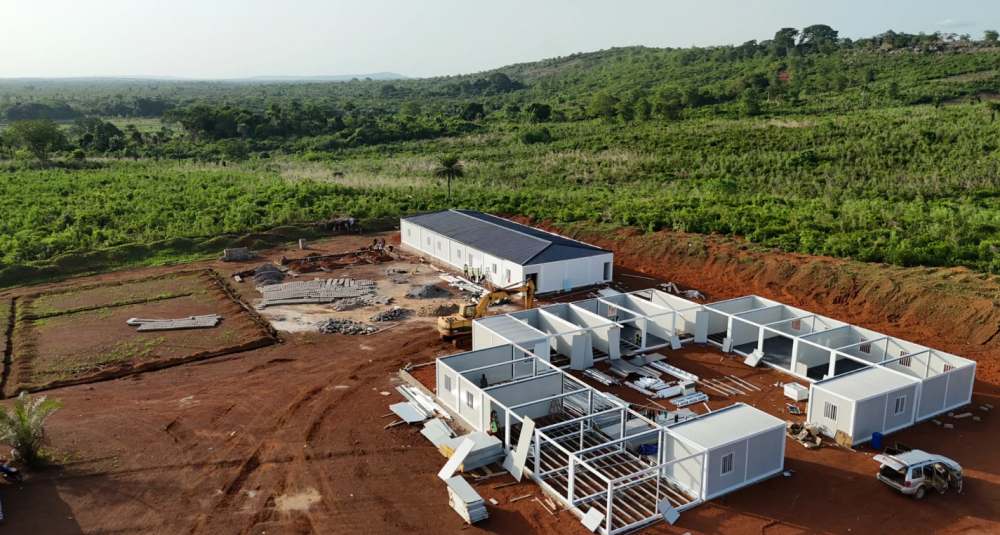
The cost of container housing for mining sites is influenced by numerous factors,one of the most significant being the specific type of container housing selected.Different types of container housing feature distinct structural designs,which impact both the unit price and the subsequent user experience.
Below are four common types of container housing used in mining sites,along with their corresponding price ranges:
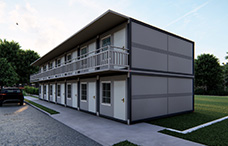
Price Range for Standard Flat-Pack Containers:$1,000–$3,000 per module
This type is typically the most common choice for mining projects.Its structure is designed to be disassembled for transport and then quickly assembled on-site using simple procedures.Because of its compact shipping volume,a single shipment can accommodate a larger number of units,offering distinct cost advantages in large-scale projects.
In terms of application,this type of container housing functions primarily as a"basic unit."It is frequently utilized as multi-occupant dormitory housing,featuring relatively simple interior configurations—such as bunk beds,basic lighting,and ventilation systems.For mining projects characterized by short timelines and large workforces,this represents a pragmatic and highly efficient housing solution.
Price Range for Folding Container Houses:$2,000–$5,000 per module
The defining characteristic of the folding structure is its"ready-to-use upon arrival"nature.Its volume is compressed during transport;once it reaches the site,it simply needs to be unfolded to become operational,thereby significantly reducing installation time and labor costs.
This type is particularly well-suited for mining sites with complex transportation conditions—such as areas with underdeveloped roads or strict time constraints on construction.Although the unit price is slightly higher than that of standard flat-pack containers,the time saved on installation can actually result in lower overall costs for the entire project.
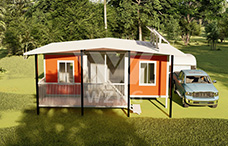
Price Range for Expandable Container Houses:$4,000–$10,000+per module
While the previous two types lean more toward"functionality,"expandable container houses are closer to providing a true"residential living space."They ship at standard dimensions,but upon arrival at the site,their structures are expanded to increase the usable floor area—potentially doubling or even more than doubling the available space.
At mining sites,these units are typically not deployed on a massive scale;instead,they are allocated to specific zones—such as management staff dormitories,offices,or medical facilities.Compared to standard dormitories,they offer superior privacy and comfort,featuring amenities such as private bathrooms,air conditioning systems,and more ergonomic spatial layouts.
From a budgetary perspective,investing in these units is considered an expenditure aimed at"enhancing the user experience,"rather than a strictly essential component of basic infrastructure.
Price Range for Modular Combination Container Houses:$300,000–$2,000,000+for an entire project
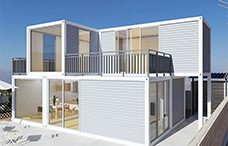
As the scale of a mining operation expands,individual container units often become insufficient to meet operational needs.At this juncture,a"modular combination"approach is adopted,involving the interconnection of multiple container units to form a single,cohesive spatial complex.
This configuration is commonly utilized for facilities such as dining halls,office buildings,conference rooms,and even recreational areas.By structurally joining multiple units,it is possible to create more expansive interior spaces,thereby offering a user experience that closely resembles that of traditional permanent architecture.
In mining projects,"container houses"are not a single-purpose product;rather,the specific function assigned to each unit directly influences the composition of the associated costs.
Price Range:$1,000–$8,000 per unit
Accommodation modules typically account for the largest portion of a camp's overall budget.Ranging from multi-occupancy dormitories to private single suites,price variations are primarily driven by differences in spatial allocation and privacy levels.
In a typical mining site,worker dormitories often feature multi-occupancy designs to keep costs in check;conversely,management staff or long-term on-site personnel are usually assigned higher-spec single or double rooms.This tiered design strikes a balance between budgetary control and enhancing the resident experience.
Price Range:$2,000–$10,000 per module
Although sanitary units—comprising restrooms and shower rooms—are relatively small in area,they impose stringent requirements on plumbing systems,waterproofing,and electrical wiring;consequently,the cost per individual unit is often higher than that of standard dormitory units.
Many projects opt for centralized sanitary facilities,a strategy that minimizes redundant construction efforts and reduces overall costs.While equipping every individual room with a private en-suite bathroom offers superior comfort,it results in a significantly higher budgetary outlay.
Price Range:$5,000–$100,000+(depending on scale)
Canteens and kitchens are indispensable components of any mining site.Small-scale projects may require nothing more than a basic kitchen module,whereas large-scale mining operations necessitate a comprehensive dining system—including dedicated areas for food storage,preparation,and dining.
As the scale of the operation expands,the associated costs for this specific category tend to rise quite significantly.
Price Range:$3,000–$20,000 per unit
In remote mining locations,medical modules are often a mandatory requirement.These medical units are subject to exceptionally rigorous standards regarding hygiene and safety.Consequently,the specifications and amenities of these container units typically surpass those found in standard dormitory accommodations.
For small-scale mining operations,budgets are often limited,and the primary construction objective is to achieve"rapid deployment"and operational readiness.Typically,standard flat-pack container units are utilized as dormitory housing,complemented by a centralized sanitary module and a simple kitchen facility.
The overall structure of the camp is relatively simple,lacking complex functional zoning.This approach allows for rapid construction within a short timeframe while keeping costs at a low level.
As the personnel scale expands,the camp begins to exhibit more distinct functional zoning.In addition to basic dormitory units,a number of single or double occupancy rooms are typically added to accommodate the specific needs of personnel in various roles.
Concurrently,the canteen and office areas are constructed using modular assembly methods to optimize spatial utilization.At this stage,the project begins to transition from being merely"functional"to being"highly practical."
In large-scale mining operations,the container camp evolves beyond mere temporary accommodation to resemble a complete,self-contained community.Functions such as accommodation,dining,administration,medical care,and recreation are all systematically planned and integrated.
In this context,modular-assembly container units become the standard choice,resulting in a significant increase in overall project costs.However,this investment simultaneously yields substantial improvements in user experience and operational efficiency.
In many project quotations,the most easily overlooked factor is the cost pressure associated with transportation and infrastructure development.This is particularly true for remote mining sites,where freight charges often account for a substantial portion of the total project expenditure.
For remote mining operations,container units must be transported to the site via sea freight or long-distance overland haulage.Factors such as transport distance,road conditions,and the availability of hoisting equipment directly impact these costs.Furthermore,once the units arrive on-site,a series of subsequent tasks—including installation,utility connections(water and electricity),and sewage treatment—must be completed.
Transportation costs frequently account for 30%to 60%of the total project budget.This implies that even if the unit price of the containers themselves is relatively low,the final project budget may still be driven up significantly.
Therefore,when formulating a budget,one must not focus solely on the unit price of the product,but rather adopt a holistic perspective that encompasses the entire end-to-end delivery process.
When selecting container housing for a mining site,the key lies not in a simple price comparison,but in making a judgment based on the specific operational context and actual usage scenarios of the project.Only by clearly defining requirements can one effectively avoid issues such as cost overruns or functional inconveniences later in the project lifecycle.For short-term projects,priority should be given to container types that are highly standardized and easy to install—such as flat-pack or foldable structures.These solutions allow for rapid deployment and effective control of upfront investment costs.
For mining sites intended for long-term operation,it is more appropriate to opt for upgraded configurations—for instance,by introducing expandable or modular-spliced container housing units.Although the initial outlay may be higher,these options enhance the living experience and offer greater long-term value.
Personnel structure is another factor that must be taken into account.For large workforces,multi-occupancy dormitories can be utilized to minimize costs;however,for management staff or technical personnel,it is advisable to provide higher-standard living quarters to ensure work efficiency and stability.
The project's geographical location also directly influences the selection process.For remote mining sites,priority should be placed on transportation efficiency and ease of construction;in such cases,selecting products with a higher unit price but simpler installation requirements can actually result in lower overall project costs.
Furthermore,the potential for future expansion must be considered.By choosing solutions that feature modularity and scalability,you create room for future adjustments and expansions,thereby avoiding the need for redundant investments.
Before finalizing your camp layout plan for a mining site,selecting a reliable supplier is a critical step.WZHhouse is a manufacturer of containerized housing units that offers not only the products themselves but also comprehensive,end-to-end solutions.
WZHhouse container housing solutions offer the following key advantages:
Diverse Product Portfolio to Meet Varied Mining Site Needs:WZHhouse covers a wide range of container housing types commonly used in mining operations,including standard flat-pack containers,foldable units,expandable modules,and modular combination units.Whether you are undertaking a short-term project or establishing a long-term operational camp,you can find a suitable solution to fit your requirements.
Customized Solutions Tailored to Real-World Project Scenarios:Mining sites vary significantly in terms of personnel scale,climatic conditions,and operational duration.We offer customized design services—ranging from layout planning to functional configuration—to create camp solutions that are precisely aligned with the specific needs and practical realities of your project.
Direct Factory Manufacturing for Greater Control over Quality and Cost:As a direct manufacturer,WZHhouse is deeply involved in every stage of the production process,maintaining strict quality control over both materials and craftsmanship.By eliminating intermediaries,we ensure more reasonable overall pricing—a benefit that is particularly advantageous for large-scale procurement projects.
Extensive Project Experience and Comprehensive Solutions:We offer more than just individual products;we assist with the holistic planning of your mining camp—including the integrated design of functional modules for accommodation,offices,dining facilities,sanitation,and more—thereby enhancing the efficiency of project implementation.
Early-Stage Support and Solution Optimization to Streamline Decision-Making:During the initial planning phase,we provide assistance with budget estimation and solution comparisons.This helps clients clearly understand the differences between various configurations,enabling them to make more informed and rational decisions.
If you are currently planning a mining camp project,or if you require a clear budget and configuration proposal,please feel free to contact us to discuss your specific needs.We are ready to provide you with highly targeted recommendations and customized solutions.
So,what is the actual cost of container housing for mining camps?Ranging from basic modules priced at$1,000 to high-specification units exceeding$10,000—and extending to complete camp projects costing hundreds of thousands or even millions of dollars—the primary driver behind these price variations is invariably the specific combination of solutions selected.
From the most basic single-container dwelling to a complete mining camp encompassing accommodation,offices,dining facilities,and logistical support systems,the budget structure shifts with the addition of every functional module;similarly,costs rise in tandem with every upgrade in operational standards.
Once you grasp the interrelationships between key factors—such as unit type,functional purpose,personnel scale,and logistics/infrastructure requirements—your focus will naturally shift from the simple question of"How much does a single container cost?"to the more strategic objective of"How do we construct a rational and efficient camp system?"



Copyright © Hebei Weizhengheng Modular House Technology Co., Ltd. All Rights Reserved
Sitemap

 +8615081877521
 +8615081877521