- icy@wzhgroup.com
- +86 15081877521


In recent years—whether for overseas engineering projects,mining camps,or temporary office spaces—the demand for building solutions that are"quick to construct,cost-effective,and adaptable on the fly"has become increasingly evident.While traditional construction methods certainly offer stability,they are characterized by long timelines and numerous on-site variables;consequently,whenever a project faces a tight schedule,delays in progress can easily occur.
Against this backdrop,the"Expandable Container House"has begun to attract significant attention from a growing number of property owners and contractors.When encountering this concept for the first time,many clients invariably ask two straightforward questions:What exactly is it?And how does it achieve such rapid assembly?
In essence,the Expandable Container House emerged specifically to address the market's need for a housing solution that offers quick,simple construction and efficient deployment.The following sections provide a detailed introduction to what a container house is and how it functions.
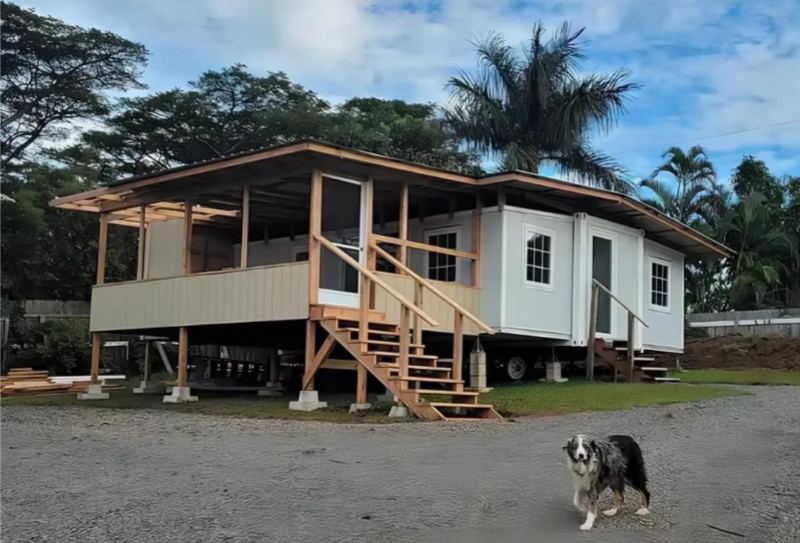
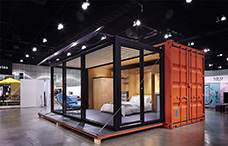
Simply put,an expandable container house is a modular building unit designed to be folded for transport and subsequently unfolded for use upon arrival at the project site.It leaves the factory in a compressed state—occupying a volume roughly equivalent to that of a standard shipping container—yet can be expanded to create a significantly larger living or working space when deployed.
The core principle driving the research,development,and production of expandable container houses is the optimization of two factors:minimizing transport volume while maximizing usable space.In other words,the goal is to maximize the usable floor area available after installation,without incurring additional transportation costs.
Compared to traditional container houses,the most significant distinction lies in their"transformability."Standard container houses feature fixed dimensions,whereas expandable units—thanks to their innovative structural design—allow for the expansion and utilization of additional space directly at the project site.This feature offers a distinct advantage in terms of logistics,potentially helping you reduce transportation costs by as much as one-third.
On the surface,an expandable container house may resemble an ordinary shipping container;in reality,however,it functions more as an"expandable spatial module."You can visualize it as a compressed house—a compact box during transit that is subsequently"opened up"once it reaches its final destination.Its structure is not merely a simple assembly of parts,but rather a fully integrated system designed in advance within a factory.It primarily consists of the following components:
Main steel structural frame(the load-bearing core)
Folding wall system(side walls or"wings")
Hinge and sliding rail mechanisms(enabling expansion)
Roof and flooring systems(ensuring overall stability)
Pre-installed doors,windows,electrical wiring,and basic fixtures
The core objective behind this structural design for expandable container housing is singular:to complete the complex construction process in advance,thereby reducing on-site work to a simple process of"unfolding"and"connecting."
Precisely for this reason,in practical applications,this type of product proves far more efficient—and offers better quality control—than traditional on-site construction methods.
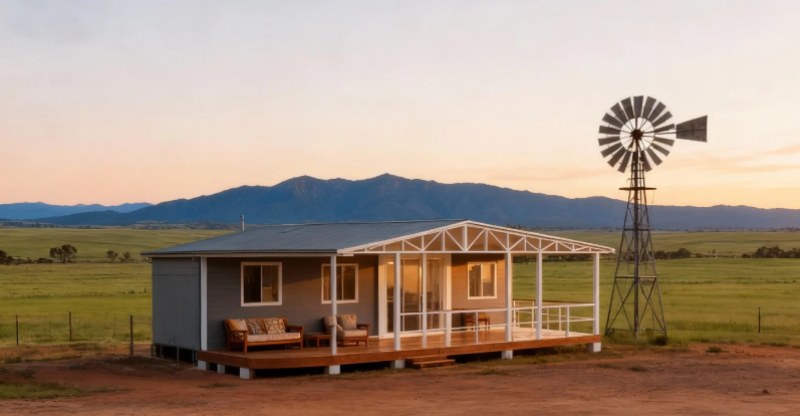
In actual projects,the advantages of expandable container housing are often best demonstrated through comparison.Whether compared to traditional buildings or standard container homes,this solution offers significant improvements in terms of transportation,construction,and operational efficiency.Consequently,an increasing number of projects are now adopting this approach.
Expandable container homes remain in a folded state during transit,thereby occupying less space.A single 40HQ shipping container can typically accommodate 2 to 3 units,whereas a standard container home usually occupies an entire container by itself.
This difference is critical in international projects,where overall transportation costs can typically be reduced by approximately 30%–50%.This is particularly advantageous for bulk purchases or scenarios involving long-distance shipping.
Traditional buildings often require weeks—or even longer—to construct,whereas approximately 90%of the fabrication work for expandable container homes is completed at the factory.On-site work is limited to simply unfolding the unit and making basic connections.
A single unit can typically be fully installed within 1 to 2 hours,and a small-scale project(involving approximately 10 units)can generally be completed within a single day.This results in an overall efficiency gain of 80%to 90%.
Traditional construction requires the coordination of multiple trades and entails significant manual labor input.In contrast,expandable container housing shifts the majority of the work to the factory environment,meaning that on-site completion requires only a small team to assist with the lifting and unfolding process.Typically,the on-site workforce can be reduced by 50%–70%;this is particularly significant for overseas projects or in regions where labor costs are high.
These units are designed to be folded and unfolded multiple times;under normal operating conditions,they can be reused 5 to 10 times or more.Compared to single-use structures,they offer significantly higher overall utilization efficiency.
For construction camps or phased projects,long-term costs can typically be reduced by over 30%,while also facilitating easier relocation and reconfiguration in the future.
Standard container units offer fixed interior dimensions,whereas expandable container units—once fully deployed—typically provide a floor area that is two,or even two to three,times larger than their original size.
This ability to gain significantly more usable space without increasing transport volume is highly practical for both office and residential applications.
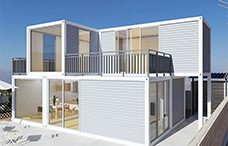
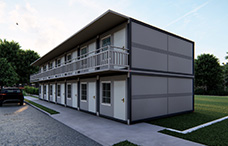
Expandable container units can be utilized individually or combined into multi-unit clusters to rapidly create larger functional spaces,such as dormitory complexes or office zones.
This"modular assembly"approach offers greater flexibility than traditional construction methods and is better suited to accommodate the ever-evolving requirements of a project.
While expandable container units excel in terms of efficiency and flexibility,they remain a form of modular prefabricated construction and are subject to certain inherent limitations when deployed in long-term scenarios or extreme environmental conditions.These potential issues are typically a primary focus of attention during the initial planning stages of a project.
Compared to traditional reinforced concrete structures,expandable container units generally have a shorter service life—typically ranging from 10 to 15 years—depending on the specific operating environment and maintenance regimen.In environments characterized by high humidity,intense UV radiation,or frequent relocation,the structural components and surface materials may degrade at an accelerated rate.
Consequently,these units are better suited for short-to-medium-term applications or mobile projects,rather than for permanent construction requirements.
Regulatory approval standards for these units vary significantly across different countries and regions.Some jurisdictions classify them as temporary structures,allowing for expedited approval processes;others,however,require them to undergo additional certification to ensure full compliance with standard building codes and regulations.Particularly in projects involving strict urban planning regulations or permanent land use,it may be necessary to provide structural calculation reports,fire-resistance certification,and foundation engineering documentation;therefore,local regulatory requirements must be verified in advance before implementation begins.
Under standard configurations,expandable container homes can withstand general climatic conditions.However,in regions prone to strong winds,heavy snowfall,or frequent typhoons,additional structural reinforcements—such as adding steel structural supports or reinforcing connection points—are mandatory.
Generally,standard products can handle wind forces of approximately Level 8 to 10 on the Beaufort scale;however,if a project is located in a coastal area or a high-wind-speed zone,the structural design must be upgraded to a higher classification.
As these structures are inherently based on a light-gauge steel framework system,their thermal insulation performance relies primarily on the wall materials and the layered structure of the panels.If a basic configuration is selected,indoor temperature fluctuations may be significant in regions with extreme cold or heat;consequently,additional insulation layers or air conditioning systems may be required to maintain indoor comfort.
In practical projects,this aspect often constitutes one of the major variables affecting overall cost;differing configurations can result in noticeably different levels of user comfort and experience.
Although expandable container homes are reusable,their fundamental design philosophy centers on"rapid deployment+flexible mobility."If a project's objective is to construct a permanent structure intended to remain in place for several decades without relocation,traditional construction methods typically offer greater advantages.
Therefore,when making a selection,it is more appropriate to view these units as a"highly efficient building solution"rather than as a complete substitute for traditional permanent architecture.
In practical applications,expandable container homes are best suited for projects with specific requirements regarding"speed"and"flexibility."Compared to traditional construction,their primary advantage lies in their ability to be deployed rapidly and subsequently adjusted or relocated as project needs evolve.
Currently,the most common application scenarios include the following categories:
Mining Camps
Emergency Shelter Housing
Construction Site Dormitories and On-Site Offices
Temporary Commercial Spaces
Government and Infrastructure Support Projects
Backyard Units(Accessory Dwelling Units)
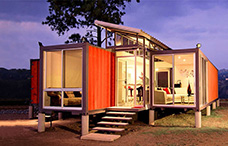
Campgrounds and Vacation Accommodations
If a project is characterized by both a"tight construction schedule"and a"need for mobility,"then an expandable container home typically represents the most suitable choice.
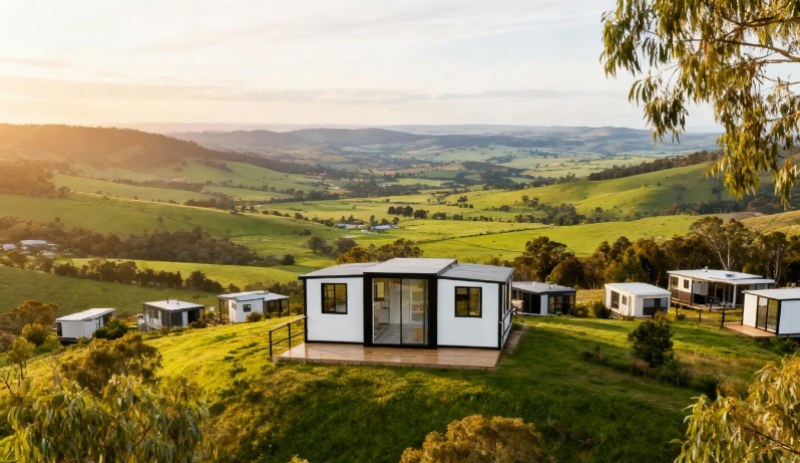
What many clients truly care about is not the structure itself,but rather:how exactly does it get from the factory to the site and transform into a usable space?
With expandable container homes,90%of the work is completed at the factory.During transport,the units remain in a folded state,thereby reducing shipping costs.A single 40HQ container can typically accommodate 2 to 3 folded units,whereas a traditional fixed-structure container home usually occupies an entire container by itself;consequently,overall loading efficiency is boosted by approximately 1.5 to 2 times.
This factor is particularly critical when purchasing expandable container homes from China.Shipping costs often account for 20%to 40%of the total budget;by minimizing volume through a foldable design,overall logistics costs can typically be reduced by 30%to 50%.
Once the product arrives on-site,the actual installation process is far simpler than most people imagine.Since the majority of the structural work has already been completed at the factory,the on-site workflow primarily consists of"unfolding+securing+connecting."The entire process can be broken down into the following steps:
Before installation begins,you must first complete the foundation preparation work.Typically,a relatively level concrete slab or a steel-structure support base is all that is required;unlike traditional construction projects,there is no need for deep foundation excavation.
The primary function of this foundation is to ensure overall structural stability and provide anchor points for subsequent securing operations.For temporary projects,simplified foundation solutions—such as prefabricated concrete blocks—can even be utilized to further reduce construction time.
Once the foundation is complete,the process moves to the lifting phase.Using a crane or other hoisting equipment,the folded container unit is lifted in its entirety and lowered into its designated position.
During this stage,the primary focus is on precise positioning and leveling to ensure that the spacing and orientation of each unit align with the design specifications.Once the unit is successfully positioned,you can proceed to the next step:the unfolding operation.
This is the most critical step in the entire installation process—the moment where the concept of"expandability"truly comes to life.
First,the foldable side walls or"wing"structures—which remained folded inward during transport—are opened outward.Subsequently,using either manual effort or mechanical assistance,the expandable sections are gradually extended outward,transforming the unit from its folded state into a fully realized,usable space.During the expansion process,structural docking and locking occur simultaneously,ensuring that the extended sections integrate with the main framework to form a unified load-bearing system.Once the left/right or single-sided extensions are fully deployed,they undergo fixation and reinforcement to stabilize the entire structure.
Upon the completion of this stage,what began as a compact container unit has been transformed into a fully functional living or working space.
With the structural work complete,the next step involves connecting the functional systems—specifically water,electricity,and drainage.
Typically,the necessary interfaces for these systems are pre-installed during the factory production phase;therefore,on-site work requires only simple docking,eliminating the need for complex wiring or structural modifications.If project requirements dictate,air conditioning systems or other equipment can also be integrated to ensure the space is fully ready for immediate occupancy.
The final step involves simple interior finishing touches,including checking the seals on doors and windows,cleaning up any dust accumulated during transport,and making minor adjustments based on specific needs.
Once these steps are completed,the entire unit is officially ready for use.For standard projects,the entire process—from hoisting the unit into place to achieving a fully habitable state—can typically be completed within a very short timeframe.
When selecting an expandable container house,clients are often less concerned with the product itself than with the supplier's ability to ensure reliable delivery,comply with local regulations,and mitigate risks throughout the project execution phase.Viewed from this perspective,WZHhouse positions itself as a provider of comprehensive project solutions—going far beyond merely supplying the physical product.
Requirements for container houses vary significantly across different countries and projects;some prioritize structural strength,others focus on thermal insulation,while others demand specific layouts or functional spaces.
WZHhouse OEM and customized manufacturing,allowing for adjustments to dimensions,structural design,and interior configurations to align with specific project needs.This approach helps clients better adapt to local market demands while minimizing the costs associated with subsequent modifications.
For export-oriented projects,regulatory compliance is paramount.Failure to meet local standards can lead to complications during customs clearance or final project acceptance.
To address this,WZHhouse products can be provided with certifications such as CE and ISO—tailored to the specific requirements of different markets.Furthermore,we provide comprehensive structural calculations and technical documentation to help clients minimize uncertainties during the approval and implementation phases of their projects.
In real-world projects,clients frequently encounter challenges such as inconsistent quality,high transportation costs,complex on-site installation,and a lack of reusability in the long run.
Through standardized manufacturing,collapsible transport designs,and modular structural systems,these issues can be optimized during the initial design phase,thereby ensuring smoother project execution and significantly lower overall risk.
These solutions are particularly well-suited for scenarios demanding high levels of efficiency and stability—such as overseas engineering projects,mining camps,temporary offices and accommodations,as well as emergency response or government-led initiatives.
Viewed holistically,WZHhouse offers more than just expandable container homes;we provide a comprehensive support ecosystem tailored to specific project requirements.By leveraging our customization capabilities and regulatory compliance support,we help clients mitigate risks and boost efficiency during the actual implementation phase.
If you are currently planning a project but are unsure which type of expandable container home best fits your needs,please feel free to share your requirements with us.Based on your intended application,budget,and local environmental conditions,we will develop a practical,real-world solution proposal designed to make your initial decision-making clearer and your project risks more manageable.
Returning to our initial question—what,fundamentally,is an Expandable Container House?—it can be understood in a very intuitive way:it is an architectural form in which the majority of the construction process is completed in advance at a factory,thereby simplifying"on-site construction"into a rapid process of unfolding and connecting components.In other words,it does not alter the essence of the building itself,but rather transforms the*method*by which that building is realized.
By utilizing collapsible designs to resolve issues regarding transport volume,leveraging factory prefabrication to boost overall efficiency,and integrating modular structures,the resulting spaces can be flexibly combined to meet specific project demands.This approach ensures that construction is no longer entirely dependent on variable on-site conditions;instead,it evolves into a more controllable and standardized delivery model.
For numerous projects with strict requirements regarding timelines,costs,and deployment efficiency,this solution is not intended to replace traditional construction methods,but rather to offer a more efficient and flexible alternative within specific contexts.



Copyright © Hebei Weizhengheng Modular House Technology Co., Ltd. All Rights Reserved
Sitemap

 +8615081877521
 +8615081877521