- icy@wzhgroup.com
- +86 15081877521


Overall,considering only construction costs and construction time,container homes are generally cheaper than traditional houses.They have lower material costs,faster construction times,and lower maintenance costs.Their modular design allows for flexible combinations and relocation,making them ideal for people with limited budgets or those seeking quick occupancy.Traditional houses,while requiring a higher initial investment,are suitable for long-term living,those needing large spaces,and those who prioritize property value appreciation.
In today's context of diversified housing needs,this question is becoming increasingly important.Whether it's a self-built home,a vacation home,or an investment property,understanding the cost structure and use cases is crucial for decision-making.
This article will provide a comprehensive analysis of traditional houses and container homes from multiple perspectives,including construction costs,material and labor costs,construction time,long-term maintenance,and applicable scenarios,to help you rationally determine which type of housing is more cost-effective.
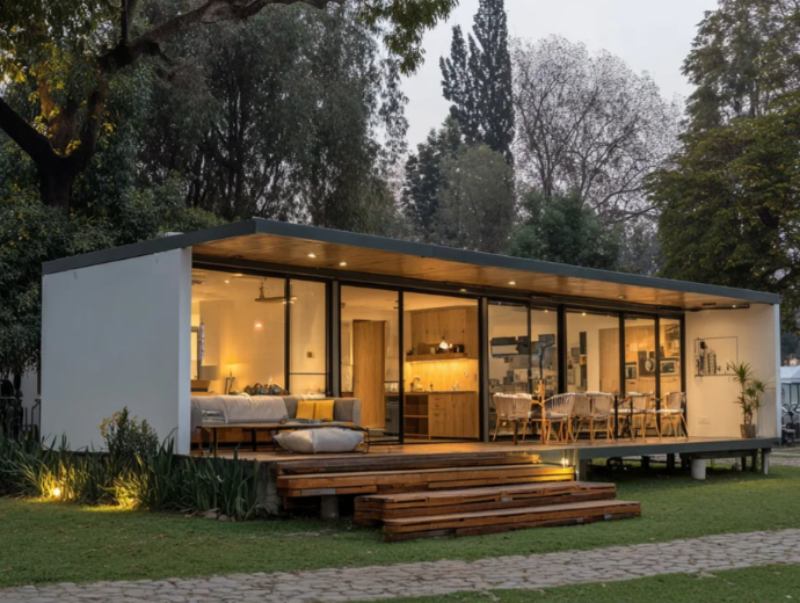
Total construction cost of a traditional house:approximately$150,000–$300,000,mainly comprising land,design,materials,labor,and long-term maintenance.
Total cost:approximately$50,000–$150,000
Land costs account for a very large proportion of the total construction cost,with significant variations across different regions.In the suburbs of the United States,a 100-square-meter residential plot might cost around$50,000,while in the center of a large city,this cost could reach$150,000 or even more.Location and urban planning directly affect land costs and are important factors in determining the total cost.
In addition to the land itself,house design and approval are also fixed expenses.Hiring a professional architect to design the house plan and paying government approval and building permit fees will cost approximately$5,000–$15,000.These costs are not negligible for first-time homebuyers.
High land and design costs mean that sufficient funds need to be allocated in the initial budget,which also affects subsequent construction arrangements and financing plans.
Total cost:approximately$60,000–$120,000
Materials for traditional houses include bricks,concrete,rebar,wood,and cement mortar,etc.Taking a 100-square-meter house as an example,the cost of mid-range materials is typically around$60,000,while high-end materials can further increase the total cost.
Material costs depend not only on the building area and material quality but also on transportation costs and regional market price fluctuations.In some remote areas,material transportation costs may account for 10–20%of the total cost.
Therefore,choosing appropriate material types and procurement channels can maximize cost control while ensuring quality,durability,and comfort of the house.
Total cost:Approximately$50,000–$80,000
Labor costs account for a significant portion of traditional house construction.The construction period is usually 6–12 months,involving construction workers,professional construction teams,supervisors,and plumbing and electrical installers.Labor costs are directly affected by the construction period;the longer the construction time,the higher the cost.
Complex designs,special construction techniques,or high-standard renovations will further increase labor costs.For example,high-ceiling designs or custom doors and windows may add extra expenses.
In addition,a longer construction period means increased capital tie-up time,and loan interest or capital costs also need to be included in the total budget.
Total cost:Approximately$2,000–$6,000/year
Traditional houses require continuous maintenance during their use,including waterproofing and moisture-proofing of walls and roofs,inspection and repair of plumbing and electrical lines,and renovation.Annual maintenance costs typically range from$2,000 to$6,000.
Climate conditions in different regions also affect maintenance costs.For example,rainy or coastal areas have higher waterproofing and moisture-proofing costs,while cold regions may increase heating system maintenance costs.
Long-term maintenance costs are a significant part of the total cost of ownership,and a reasonable budget can avoid large future expenses.
Total cost:Approximately$5,000–$15,000(loan interest or capital tie-up)
Traditional house construction has a long construction period,usually 6–12 months,which means that capital is tied up for a longer time.If the house is built with a loan,corresponding interest needs to be paid,and this cost may be as high as$5,000–$15,000.For users who want to move in quickly or are looking for investment returns,the long construction period of traditional housing may reduce capital efficiency,requiring advance financial planning.
Total construction cost of a container house:Approximately$25,000–$60,000,including the price of the container itself and the modification costs.It has the advantages of modularity and rapid construction,and is suitable for short-term living and people with limited budgets.
Total cost:Approximately$10,000–$20,000
The price of a container house body is much lower than the cost of traditional housing materials.New or used 20-foot or 40-foot containers can be used as living units,costing between$10,000 and$20,000.
The modular nature of container houses means they can be quickly expanded or combined as needed,and multiple containers can be combined to form large-space buildings,offering great flexibility.
In addition,containers are highly durable,and the maintenance of the body is relatively simple,laying the foundation for subsequent modifications and use.
Total cost:Approximately$15,000–$30,000
The container body needs to be modified to be suitable for living,including insulation,waterproofing,fireproofing,door and window installation,electrical wiring,and interior decoration.The total cost for mid-range modifications is approximately$15,000–$30,000,and high-end modifications may cost more.
Modification costs are flexible and can be adjusted according to budget and usage requirements.If it's only for short-term living or temporary use,modifications can be simplified;if comfort and high-end decoration are desired,the modification costs will increase.
Insulation and waterproofing are crucial,especially in extreme climates,ensuring indoor comfort and lifespan.
Total cost:Approximately$3,000–$7,000
The construction period for container houses is extremely short,generally 1–4 weeks for installation.Labor costs and construction equipment costs are approximately$3,000–$7,000,saving a significant amount compared to traditional housing.
Rapid construction not only reduces labor costs but also shortens the time capital is tied up,improving construction efficiency,making it suitable for users with limited budgets or tight deadlines.Modular design also allows for a combination of prefabrication and on-site assembly,further reducing construction costs.
Total cost:Approximately$300–$1,000/year
Container homes have relatively low maintenance costs,mainly including rust prevention,corrosion protection,waterproofing,and maintenance of air conditioning and ventilation systems.Annual maintenance costs are approximately$300–$1,000.
Proper protective measures can extend the lifespan of container homes and reduce long-term costs.Compared to traditional houses,maintenance expenses are only 1/3 or even less.
Total cost savings potential:$5,000–$15,000
Container homes can be disassembled,moved,or reassembled,reducing the cost of land acquisition or reconstruction without altering the structure itself.For investment projects,vacation homes,or temporary housing,this feature can save thousands to tens of thousands of dollars.
High flexibility is also a major advantage of container homes,making them more attractive in budget-constrained or short-term use scenarios.
When considering building a house,many users are most concerned about the overall cost and the differences in various expenses.To more clearly compare the economics of traditional houses and container homes,we use a 100-square-meter(approximately 1,076 square feet)residence as an example,summarizing the main costs including land,materials,labor,decoration,maintenance,and construction time.
Through the table below,you can clearly see the differences between the two types of housing in terms of initial investment,long-term maintenance,and construction flexibility,making it easier to determine which option is more suitable for your budget and needs.
| Project | Traditional House | Container House |
|---|---|---|
| Land Cost | $20,000–$250,000 | Equivalent land cost |
| Material Cost | $40,000–$90,000 | $10,000–$20,000 |
| Labor and Construction Costs | $45,000–$100,000 | $2,500–$7,000 |
| Renovation and Decoration | $20,000–$40,000 | $10,000–$25,000 |
| Maintenance Costs (Annual) | $1,800–$6,000 | $300–$1,000 |
| Construction Period | 6–12 months | 1–4 weeks |
| Mobility | None | Movable |
| Overall Cost | $150,000–$300,000+ | $15,000–$40,000+ |
The table clearly shows that container houses have significantly lower initial investment costs than traditional houses,shorter construction periods,and lower maintenance costs,making them particularly suitable for users with limited budgets who seek rapid construction and flexible use.
The cost of container houses is significantly affected by geographical location.Land prices in city centers or popular tourist areas are high,which will increase the overall construction cost.In contrast,the cost of traditional houses in city centers is often several times higher than in suburban areas,while the advantage of container houses is that they can be built in suburban areas,open plots,or on temporary land,resulting in less pressure on land costs.
In addition,coastal or rainy areas require extra rust and corrosion protection,which will also increase construction and maintenance costs.The cost difference compared to relatively dry areas can be$1,000–$5,000.
Different uses of housing have different requirements for space and comfort,which directly affects the renovation costs of container houses.
Residential use:If long-term residence is planned,the installation of complete insulation,waterproofing,heating,and ventilation systems may increase costs.Vacation Homes or Short-Term Rentals:Short-term living can utilize simplified renovation plans,such as basic insulation and simple interior design,resulting in lower costs and greater flexibility.
Office Spaces or Commercial Use:These may require special layouts,partitions,and electrical systems,increasing renovation costs.
Budgets can be flexibly adjusted depending on the intended use,and the modular design of container homes can quickly meet diverse needs.
Building approval and permit processes vary significantly across different countries and regions.Traditional houses may require longer approval cycles and multiple permits,increasing time costs and indirect expenses.
In contrast,container homes benefit from simplified approval policies in some areas,especially when used for temporary housing,resorts,or light commercial purposes,resulting in faster approval processes.This means not only saving time but also reducing potential administrative costs.
Highly customized traditional houses,such as special exterior designs,luxury renovations,or high-end materials,will significantly increase the total cost.
The modular nature of container homes makes personalized design more flexible.Whether adding windows,creating duplex spaces,or converting them into cafes or small offices,the level of renovation can be adjusted according to the budget.Flexible design options give container homes an advantage in cost control while meeting different usage needs.
Traditional houses are more suitable for families or investors seeking a long-term living experience:
Long-term living,large families:Suitable for families with multiple occupants who need separate bedrooms and living spaces.
Emphasis on comfort and asset appreciation:Traditional houses have advantages in land appreciation and property value appreciation.
Desire for durable house structure and flexible renovation space:Traditional buildings can accommodate more renovation styles and expansion needs,suitable for those who pursue personalization and long-term planning.
In short,if users prioritize living comfort,long-term use,and property appreciation,traditional houses remain the best choice.
Container homes are more suitable for people seeking flexibility,rapid construction,and low costs:
Short-term living,tourism and vacation,or light asset investors:Suitable for vacation homes,Airbnb rentals,or temporary accommodation projects.
Seeking quick occupancy or low-cost construction:Short construction period,low initial investment,and quick deployment.Requires flexible relocation or modular expansion:Units can be added or removed as needed to adapt to different sites and uses.
In addition,container homes are also suitable for creative entrepreneurs,small community offices,or outdoor event venues.The modular design and low construction costs provide an economically viable option for small businesses or experimental projects.
From the perspective of construction costs,construction time,maintenance costs,and flexibility,container homes are generally much cheaper than traditional houses in terms of initial investment,especially suitable for users with limited budgets,temporary housing needs,or investment projects.The total cost ranges from**$15,000 to$40,000**,while traditional houses usually cost**$150,000 to$300,000**or more.
However,if long-term comfort,appreciation potential,and spatial freedom are priorities,traditional houses still have irreplaceable advantages.The final choice should be based on a comprehensive assessment of budget,usage needs,and life plans.Choosing a house is not just about construction costs,but a comprehensive consideration of lifestyle and return on investment.



Copyright © Hebei Weizhengheng Modular House Technology Co., Ltd. All Rights Reserved
Sitemap

 +8615081877521
 +8615081877521