- icy@wzhgroup.com
- +86 15081877521


In recent years,container houses have gradually moved away from the label of“temporary buildings”in the Australian commercial market,becoming an efficient,stylish,and cost-effective solution for commercial spaces.Whether it’s a seaside coffee shop,a brand pop-up store on the outskirts of the city,or an office facility in a remote mining area,these modular structures are increasingly visible.
Many business owners initially focus on container houses because of cost or construction time.However,after a deeper understanding,they find that it is not merely a budget-saving choice—it is a flexible,scalable,and even brand-enhancing space strategy.This advantage is particularly significant in Australia,a country with vast land,dispersed population,and high labor costs,where modular construction truly shines.
This article will focus on commercial applications,systematically analyzing the use of container houses in the Australian market,their benefits,cost structure,and key factors to consider in actual operation.
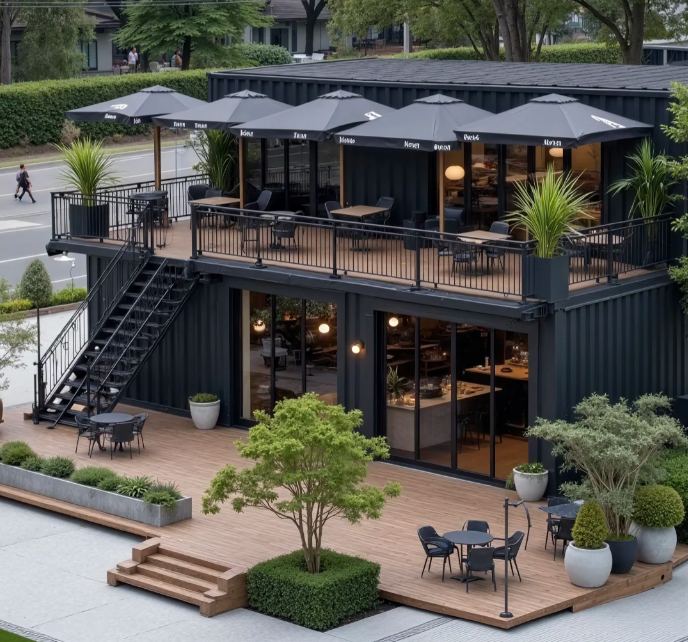
Traditional commercial buildings often take several months or longer to complete,from foundation work to structural topping,requiring coordination of labor and materials at every step.Container houses,however,are prefabricated in factories,with most structures and interior finishes completed before delivery.
Once transported to the site,only basic fixing,water and electricity connections,and minor adjustments are needed to make them operational.For commercial projects,this“rapid deployment”capability means shorter downtime and earlier revenue generation.Some food and beverage entrepreneurs even complete the entire process from order to opening within 4–6 weeks,which is almost impossible with traditional construction methods.
Labor costs in Australia are among the highest globally.Coordinating multiple trades such as bricklayers,carpenters,and electricians often significantly raises the overall budget.
In contrast,factory-produced container structures reduce on-site labor dependence,making costs more transparent.Although prices vary depending on specifications and customization levels,the unit cost per square meter is generally lower than traditional commercial buildings.
Moreover,container houses are movable.If a commercial location underperforms,the structure can be relocated,reducing long-term lease risk.This flexibility itself provides business security.
For startups,investing in a large commercial space at once can be risky.Container houses allow modular stacking or splicing designs.
For example,a business can start with a single unit,then add a second or third module as operations grow.This phased growth strategy is particularly suitable for cafes,small retail stores,or brand showcase spaces.It enables businesses to expand gradually while controlling the budget,instead of shouldering heavy initial costs.
Modern consumers increasingly care about brand image and sustainability.Container houses naturally feature industrial aesthetics that,when well-designed,can create a unique and modern commercial atmosphere.
Additionally,steel structures are recyclable,and material waste is minimal,aligning with environmental concepts.For businesses emphasizing brand story and social responsibility,this building form itself serves as a marketing expression.
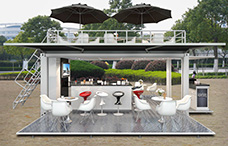
In coastal cities or tourist destinations in Australia,container cafés are increasingly common.Open windows,outdoor seating,and simple yet distinctive designs make them highly“Instagrammable.”
These structures are particularly suitable for:
Beachside cafes
Park dining points
Food stalls at music festivals or large events
They offer controlled investment while providing strong visual appeal.
When entering new markets,brands often want to test consumer response.Container houses are ideal for:
Temporary showrooms
Seasonal sales points
Outdoor brand promotion spaces at malls
Compared to traditional stores,construction is faster,and removal is convenient,offering high flexibility for marketing departments.
On construction sites or infrastructure projects,temporary office space is essential.Container structures can be quickly deployed and equipped with desks,meeting rooms,and electrical systems for immediate use.
For the mining and energy industries,this solution is especially valuable.Building traditional offices in remote areas is expensive,while modular buildings are easier to transport and more practical.
Australia’s abundant tourism resources have led to short-term rental development near rural or nature reserve areas.Container houses can serve as:
Airbnb units
Glamping reception areas
Ticketing and information centers
They provide comfort while creating a striking contrast with natural surroundings.
In mining or agricultural regions,commercial facilities are often difficult to construct quickly.Small convenience stores,cafes,or service stations can be rapidly deployed using container houses,saving time and reducing transport and construction costs.
Using container houses for commercial purposes in Australia is not as simple as“buy and use.”Success depends on careful planning,particularly regarding approvals,structure,and infrastructure.
Australian states and councils have clear but varied regulations for building approvals.For example,in New South Wales and Victoria,commercial buildings typically require Development Approval(DA)or a Building Permit,depending on land zoning and building size.
Approval usually involves:
Land use zoning
Building permits
Fire safety and emergency evacuation standards
Accessibility requirements(compliant with NCC)
Industry data show that commercial building approvals in Australia typically take 4–12 weeks,and some areas longer.Projects over 10–20 sqm open to the public almost always require formal approval.Early confirmation can prevent costly retrofits or business suspension.
Australia has complex wind conditions,especially in coastal and northern regions.According to AS/NZS 1170.2 wind zoning,some areas require design wind speeds exceeding 60 m/s.
Commercial container houses must:
Undergo professional engineering calculations to meet local wind load standards
Have properly designed foundations and anchoring systems
Ensure key connection nodes are strong
Low-end products without professional anchoring systems face safety risks under strong winds.Coastal projects require reinforced structures and windproof designs—it’s not optional but necessary.
Australia’s climate varies widely,from 40°C+in inland Western Australia to near 0°C in Tasmania winters.Thermal performance directly affects comfort and building lifespan.
Unmodified containers can be 10–15°C hotter than outdoors in summer.High-quality commercial containers typically feature:
50–100mm insulation layers
Double-layer roof insulation
Low-emissivity coatings
Multi-layer anti-corrosion systems
Coastal salt spray accelerates steel corrosion;inadequate protection can cause rust within 3–5 years.Climate adaptability affects not only comfort but also the building’s usable lifespan.
Commercial spaces require more infrastructure than residential ones.A standard cafe or small retail space usually needs:
Three-phase electrical system
Water supply and drainage
Air conditioning and ventilation
Fire alarms and sprinkler systems
Failure to plan these systems during design can increase retrofit costs by 15–30%.Mature projects usually embed wiring and integrate systems at the factory rather than relying on on-site patchwork construction.
Price is often the primary concern for businesses considering commercial container houses.In the Australian market,a basic single-unit structure typically costs AUD 8,000–15,000,suitable for simple offices or storage.
With interior finishing,air conditioning,and fire protection,mid-range custom units are AUD 20,000–40,000.High-spec engineering products,designed for durability and long-term use,can exceed AUD 50,000 per unit.
It’s important to note that structural cost usually accounts for only 40–60%of the total investment,with the remainder covering interior finishes,utilities,transportation,installation,and foundation work.Compared to traditional construction,container solutions save 20–40%of initial costs and are faster to deploy,with most commercial projects operational within 4–8 weeks.
Even so,high-spec products require significant investment.Businesses seeking long-term operation and a premium image should budget accordingly.
Many still perceive container buildings as“temporary facilities.”In reality,as long as engineering standards are met and maintenance is conducted,container houses can last 15–25 years,with high-spec units lasting even longer.
Factors affecting lifespan include steel thickness,anti-corrosion grade,surface treatment,maintenance frequency,and usage intensity.For instance,using 2.5–3.0mm high-strength steel combined with a complete anti-corrosion system can support around 20 years of commercial operation,even under frequent use.
Thus,long-term suitability depends not on the“container”form but on engineering design and manufacturing quality.Businesses should evaluate wind load compliance,anti-corrosion level,and climate adaptability rather than just appearance or initial cost.
Commercial applications demand higher safety and stability.Low-quality products may show issues within 1–3 years,such as thin steel(<1.8mm),weak weld joints,simplified corrosion protection,warped door/window frames,or worn movable components.
These problems are not obvious at delivery but affect long-term safety and maintenance costs.High-spec manufacturing rigorously controls structure load calculations,standardized welding,multi-layer corrosion protection,and factory pre-installed system testing to ensure every node withstands long-term use.
Modular standardized production allows quality control and reduces on-site construction issues.For commercial investors,choosing a manufacturer with engineering experience and a complete production system offers greater long-term value than merely selecting the lowest price.True costs include not only purchase price but also future maintenance and potential downtime risks.
In the Australian market,container houses are no longer just an alternative building form—they are a flexible,sustainable,and commercially valuable spatial strategy.Whether for cafes,retail stores,mining offices,or tourism accommodations,they demonstrate strong adaptability.Success depends not on whether a container is used,but on engineering standards,design logic,and manufacturing quality.
For businesses aiming to control costs,shorten construction cycles,and maintain operational flexibility,container houses are undoubtedly a commercial solution worth serious consideration.
WZHhouse is a professional container house manufacturer from China,specializing in modular and deployable building systems.The company has a comprehensive engineering design and manufacturing system and operates a service office in Australia for convenient local support.
WZHhouse products cover commercial offices,retail,mining facilities,and tourism accommodations.All container houses undergo strict structural calculations,corrosion protection,and quality testing to ensure long-term safety and durability.
If you are considering investing in commercial container houses in Australia,contact WZHhouse for professional consultation and customized solutions.From design to installation,their full-service support helps you efficiently achieve high-functioning commercial spaces.



Copyright © Hebei Weizhengheng Modular House Technology Co., Ltd. All Rights Reserved
Sitemap

 +8615081877521
 +8615081877521