- icy@wzhgroup.com
- +86 15081877521


The factory price for a flat-pack container home typically ranges from US$1,500 to US$9,000.A basic 20ft unit costs around US$2,000–3,500;a residential-style 20ft unit equipped with a kitchen,bathroom,and electrical system costs about US$3,500–6,000;and a 40ft residential unit generally costs US$6,000–9,000 or more.Actual prices depend primarily on size,materials,configuration,and the level of customization.
If importing from China,you must also factor in costs such as ocean freight,customs clearance,taxes,and local transportation.Below,we break down prices by size and discuss configurations,price variations,and the additional costs involved in importing from China.
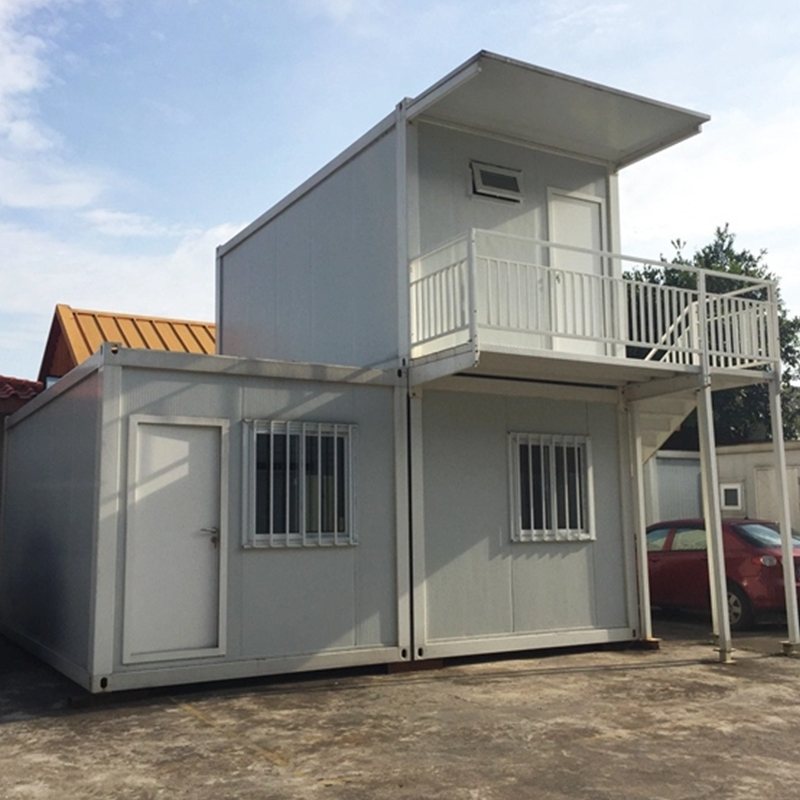
Size is the most direct factor for estimating the initial budget for a flat-pack container home.Larger units require more steel,wall panels,roofing,doors,windows,and interior materials;however,the price does not increase in exact proportion to the floor area.The price per square meter for a standardized product may actually be lower than that of a highly customized small unit.
10ft units are suitable for projects requiring compact spaces,such as small offices,temporary accommodation,or single-occupancy units.A basic structural unit costs around US$1,500–2,500,while adding insulation,electrical systems,doors,windows,and basic living amenities can bring the price to US$2,500–4,000.
Because the footprint of a 10ft unit is small,the cost of adding a bathroom or kitchen represents a significant portion of the total price.Therefore,a smaller size does not necessarily mean a lower price per square meter when fully equipped for residential use.
The 20ft flat-pack container home is a common standard size used for small-scale accommodation,offices,and compact residences.The factory price for a basic unit is approximately US$2,000–3,500,while a residential-style unit—equipped with a bathroom,kitchen,insulation,and a complete electrical system—typically costs between US$3,500 and US$6,000.Even if two products share identical external dimensions,their prices can differ significantly.A 20ft unit might consist primarily of the steel structure and enclosure system,whereas another might already include a bathroom,kitchen,and most interior systems.
A 30ft unit offers more interior space,allowing for a separate bedroom,a living room,or a larger bathroom.You can budget US$3,000–4,500 for a basic model,while a residential-configured unit might range from US$4,500 to US$7,000.
If a project requires multiple distinct functional areas,a 30ft unit is sometimes more practical than trying to cram multiple rooms into a 20ft space.
A 40ft flat-pack container home allows for a more complete interior layout,accommodating features such as a bedroom,living room,kitchen,and bathroom.The factory price for a basic model might be around US$4,000–6,000,while a fully equipped residential unit typically costs US$6,000–9,000 or more.
For large-scale projects,multiple standard units can be combined to increase the total floor area.In such cases,it is more appropriate to provide a quote based on the project's total area,room layout,and specifications,rather than simply multiplying the price of a single unit.
Price quotes for flat-pack container homes usually cover the main structure and basic components,though standard configurations vary by manufacturer.Even for 20ft or 40ft units,the final price can differ significantly depending on the steel grade,wall panels,doors,windows,and interior fixtures.
Steel Structural Frame:This typically forms the foundation of the unit,comprising steel columns,beams,the base frame,and the roof frame.Factors such as steel grade,thickness,and surface treatment affect the cost.For instance,product specifications from some Chinese suppliers may cite Q235/Q345 steel and 3.5mm structural steel.When comparing quotes,it is essential to verify specific structural parameters in addition to dimensions.
Walls and Roof:This section primarily consists of wall panels,roof panels,and the associated connection systems.Wall panels may utilize various insulation core materials such as EPS,rock wool,or PU,with thicknesses ranging from 50mm to 75mm or 100mm.Doors and windows are typically included as standard features,though variations in profiles,glass specifications,quantities,and opening mechanisms can lead to price differences.
Interior Infrastructure:For residential-style flat-pack container homes,the quote may also encompass electrical and plumbing systems,as well as bathroom and kitchen facilities—such as wiring,distribution boxes,lighting fixtures,outlets,toilets,showers,washbasins,and kitchen cabinetry.Upon receiving a quote,it is advisable to verify item-by-item whether these features are standard or optional,rather than simply comparing the total price.
While dimensions are a fundamental factor in determining price,material specifications,interior fit-out,the level of customization,and procurement volume also have a significant impact.Two 20ft flat-pack container homes of identical size can differ in price by thousands of dollars depending on the insulation panels,doors,windows,and interior fittings used.
Dimensions and Structural Specifications:Larger homes generally require more steel,wall panels,roof panels,doors,and windows,resulting in higher overall costs.The price difference between 20ft and 40ft models reflects not only the increase in length but also changes in load-bearing structures,roofing systems,and interior layouts.
Insulation Materials and Panel Thickness:EPS is typically better suited for cost-sensitive projects,whereas rock wool,PU,or PIR are options for projects requiring superior thermal insulation or fire resistance.Panel thickness must also be compared individually;for instance,one cannot simply equate the prices of 50mm,75mm,and 100mm insulation panels based solely on the fact that they all contain an insulation layer.
Interior Fit-out:There is a substantial cost difference between basic units—featuring open-plan spaces,standard electrical systems,and simple flooring—and residential units equipped with separate bedrooms,full bathrooms,kitchens,hot water systems,and interior finishes.For 20ft units,the inclusion of kitchens and bathrooms often has a particularly noticeable impact on the total price.
Customization Requirements:Non-standard dimensions,specialized doors and windows,exterior cladding,custom floor plans,and unique electrical or plumbing layouts can all increase design and production costs.If a project involves multiple units,using standardized dimensions and configurations whenever possible generally helps control the cost per unit.
Procurement Quantity:Factories may offer different pricing structures depending on whether you are purchasing a single sample or a batch of 20,50,or even 100 units.While mass production allows for the spreading of certain manufacturing,packaging,and procurement costs,the final price ultimately depends on product specifications,order volume,and the specific factory's production schedule.
The biggest difference between these two procurement methods lies not merely in the unit price of the product,but in the composition of the total cost.
If you purchase from a local supplier,the quote likely includes transportation,warehousing,import costs,local operating expenses,and the supplier's profit margin.Although the initial price appears higher,the procurement process is relatively simple;the product is already in the local market,and after-sales service and communication are usually more convenient.
If you purchase directly from a Chinese container house factory,you might receive an EXW,FOB,or CIF quote.The factory price appears much lower because international shipping and local costs in the destination country have not yet been added.Publicly listed prices from Chinese factories might show some flat-pack products below US$2,000,while fully configured residential units can cost several thousand dollars.
In many cases,purchasing directly from a Chinese factory yields a lower product price,especially when buying multiple units.China possesses a comprehensive supply chain for steel,wall panels,doors,windows,and prefabricated building components,allowing for the mass production of standardized products.
However,the real comparison isn't:
Chinese factory price vs.local product price
But rather:
Total cost after importing from China vs.final delivered price from a local supplier
For example,the FOB price from a Chinese factory for a 20-foot residential unit might be US$4,500.This does not mean the final cost is only US$4,500,as expenses for ocean freight,customs clearance,taxes,port fees,and inland transport from the destination port to the project site must also be factored in.
The situation changes when purchasing multiple units.Flat-pack structures are designed for easy disassembly,packaging,and transport;multiple units can share a single shipping container,allowing logistics costs to be distributed across each unit.
When importing a flat-pack container home from China,in addition to the factory price,you generally need to budget approximately US$1,000–4,000 per unit for import costs,including international shipping,port fees,customs clearance,and local delivery.For bulk purchases,the logistics cost per unit is usually lower,though specific expenses depend on the destination country,shipping route,number of units per container,and local import charges.
Import costs generally consist of several components.Ocean freight is the primary expense,with rates influenced by the port of departure in China,the destination port,the shipping season,container freight rates,and order volume.Because flat-pack container homes can be disassembled and stacked,the number of units that fit into a container has a significant impact on the shipping cost per unit.
This depends on the product's folded dimensions,packaging method,and configuration.For some standardized products,industry data suggests a range of approximately 4–8 units per 40ft container,though this does not apply to every product.If the product includes features such as a separate bathroom,thicker wall panels,furniture,or other accessories,the space occupied within the container increases.When purchasing,you should ask the factory to provide a packing list and container loading plan based on the specific model.
For instance,if you pay the same ocean freight fee for a 40ft container,the shipping cost allocated to each unit is naturally lower when loading 8 units compared to just 4.For bulk orders of 20,50,or even 100 units,this loading efficiency has an even more pronounced effect on the final cost per unit.
In addition to ocean freight,you must account for destination port charges,customs clearance fees,import duties and taxes,and local transportation costs.These expenses cannot be calculated using a universal global ratio,as tax rates,HS codes,port charges,and trucking distances vary by country.
If the factory provides an FOB China quote,you can calculate the product price and international logistics costs separately;if they provide a CIF quote,you need to clarify exactly which shipping costs are included.When comparing import costs,the key factors to consider are:
Factory price+Ocean freight+Port/customs fees+Taxes+Local transportation=Actual import cost of the flat-pack container home.
This approach offers several benefits:the opening sentence provides a direct answer regarding price;the second paragraph explains why there is no standard import price;and the text then naturally transitions to container loading quantities and other expenses.It also avoids redundant explanations regarding what is included in the product price versus the import costs discussed here.
When you receive a quote,do not simply look at the final dollar figure.If one supplier quotes US$2,500 for a 20ft unit while another quotes US$4,500,the first step is to verify whether both units share the same specifications.
You should compare the steel structure specifications,steel thickness,wall panel thickness,and insulation materials,and then check if doors,windows,electrical systems,plumbing,bathrooms,and kitchens are included in the quote.If importing from China,you also need to understand the packaging method and how many units fit into a 40ft container.
Shipping terms must also be confirmed.Whether the quote is EXW,FOB,or CIF determines the scope of costs borne by the supplier.A meaningful price comparison is only possible once the terms of the quote are clearly understood.
| Steel Structure Building Type | Typical Height Range | Key Influencing Factors |
|---|---|---|
| Steel Warehouse | 6–15 m | Racking, logistics, fire safety |
| Standard Steel Factory | 6–20 m | Production lines, equipment, clear height |
| Heavy Industrial Plant | 10–30 m+ | Cranes, equipment, structural loads |
| Sports Arena | 10–30 m+ | Playing area clearance, long-span requirements |
| Aircraft Hangar | 10–30 m+ | Aircraft dimensions, door openings, span |
| Multi-story Steel Building | 20–50 m+ | Number of floors, loads, seismic resistance |
| High-rise Steel Building | Over 50 m | Wind loads, seismic forces, structural system |
A low quote does not necessarily mean the lowest final cost.If a supplier offers a factory price that is US$1,000 lower but uses lower-grade steel and insulation—and excludes electrical,bathroom,or kitchen components—that price difference will likely be incurred later during additional procurement and on-site construction.
Prices for flat-pack container homes range from approximately US$1,500–2,500 for small,basic units to US$3,500–6,000 for standard 20-foot residential models,and US$6,000–9,000+for 40-foot residential models.Highly customized units or combinations of multiple modules can exceed US$15,000 per set.
The figure that truly matters is not just the factory quote,but the total cost from the factory to the project site—specifically:
Product Price+Ocean Freight+Import Costs+Local Transport+Site Preparation
If you are planning to source directly from China,WZHhouse can provide proposals and quotes for flat-pack container homes tailored to your specific dimensions,floor plans,materials,and order volume,allowing you to compare factory prices,shipping requirements,and overall project costs before placing an order.



Copyright © Hebei Weizhengheng Modular House Technology Co., Ltd. All Rights Reserved
Sitemap

 +8615081877521
 +8615081877521